Work

Websites, stores and tools that ship fast and keep ranking.

25+ selected projects from 100+ shipped: Next.js marketing sites, WooCommerce stores, custom plugins and free tools, each one built to load fast and convert.

25+
Projects
50+
Technologies
25+
Case studies

All projects

B2B SaaS

Procol Development

2024 – Present

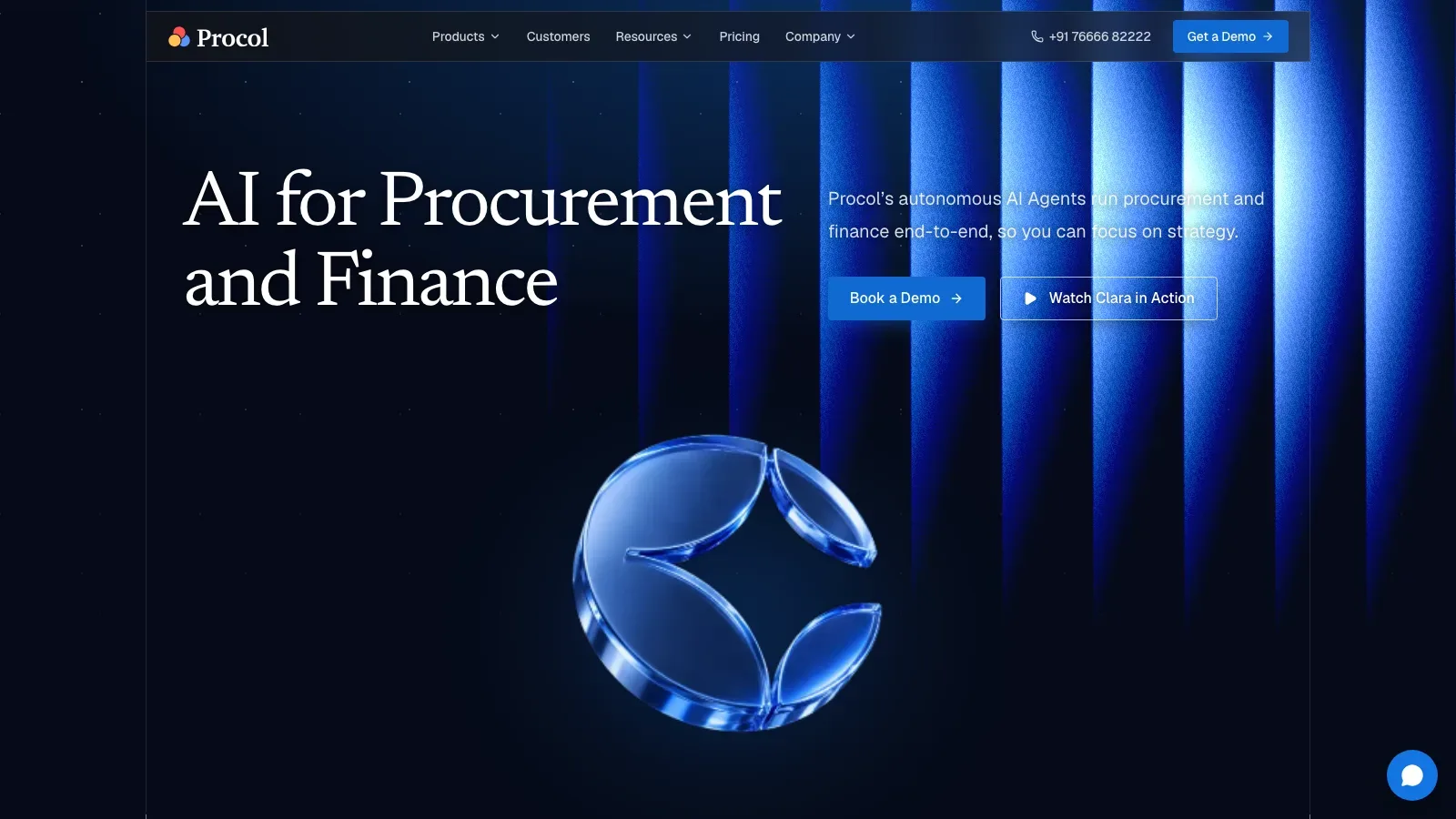
procol.ai website on Next.js, TypeScript and Tailwind CSS, built and maintained by Mohit Goyal as Senior Web Developer, including the Procol Nexus 2026 summit page. Procol sells a procurement platform to enterprise buyers, and procol.ai is where prospects first meet the product. As Senior Web Developer I build and maintain the site: the product, solution, pricing, blog and campaign pages, and event pages such as Procol Nexus 2026. I built the site on Next.js with React, TypeScript and Tailwind CSS. Every page is server rendered, so the HTML arrives complete and pages load fast on phones. Pages are assembled from a shared library of typed components, so a new landing page reuses tested sections rather than starting from a blank canvas. The SEO foundations are built in: structured data, generated sitemaps, canonical URLs and optimised images, all generated from the same content the pages render so they cannot drift out of sync. Procol Nexus 2026 is Procol's invite-only summit for procurement, finance and IT leaders, and its page lives at procol.ai/nexus. It opens on a full-screen video hero that visitors scroll into, with Framer Motion carrying them from the opening frame into the event details and a registration form for invited guests. The video is treated as progressive enhancement, so the page stays usable while it loads. It runs on the same codebase as the rest of the site, so it is server rendered, indexable and on-brand without a separate microsite. The site is live at procol.ai, and I continue to ship new pages as the product grows. The lesson I keep coming back to: a campaign or event page does not need its own stack to feel special. Strong design, careful motion and fast server-rendered pages do the work. Thinking about moving a marketing site to Next.js, or launching an event page? Send me your next project and I will reply with a plan.

Next.js React TypeScript Tailwind CSS

Personal project

mohitgoyal.in AI Portfolio

2025 – Present

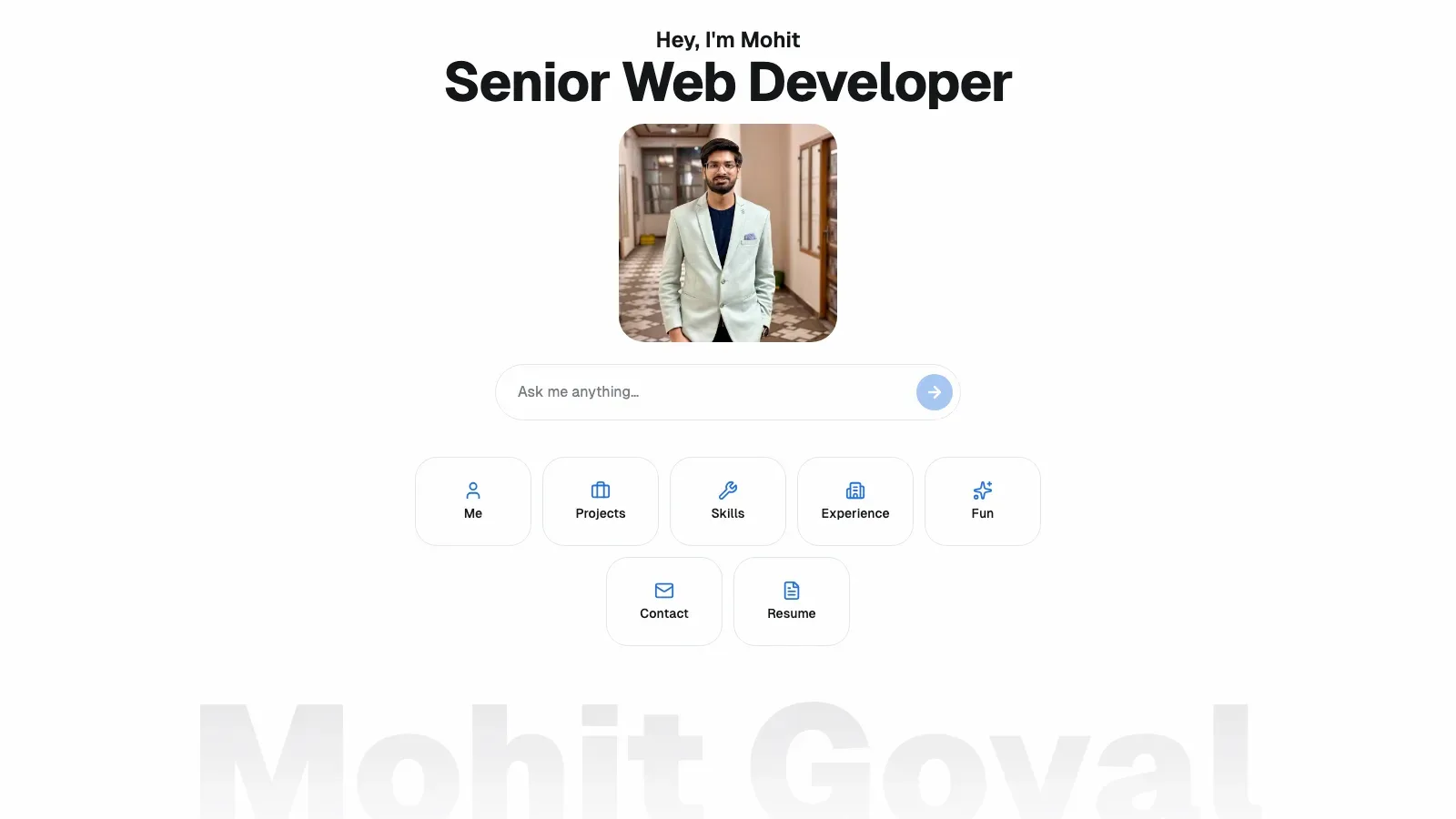
mohitgoyal.in is my AI portfolio site on TanStack Start and React, by Mohit Goyal with a chat that answers as me on the Anthropic Claude API and Firestore. It replaces the brochure portfolio with something a visitor can question, and it doubles as the place where I test the techniques I use for clients. The problem with most portfolios, including my earlier ones, is that they are static brochures. A visitor has to read every section to find out whether I have worked with their stack, and the content goes stale the moment a project changes. I wanted a portfolio that behaves less like a brochure and more like a conversation. A visitor can ask about my work and get an answer in first person, and updating a project updates everything downstream without me editing three places. The 2026 revamp is the version you are reading now. The site is a server-rendered React app on TanStack Start, hosted on Cloudflare. Visitors can read the usual sections or ask the chat about my work. The chat answers as me with structured replies, backed by the Anthropic Claude API and a system prompt built from my Firestore profile, so updating a project updates what the chat knows. Every project has a standalone SEO page at /projects/<slug>, 35+ of them live. Case studies at /case-studies/<slug> and posts at /blog/<slug> are rendered from markdown files in the repo. Service pages at /services/<slug> carry deliverables, a process and an FAQ. A site header and footer sit on a lined grid layout with Syne headings and Satoshi body type. Behind the public site is an admin dashboard where I edit every section. It has version history so I can roll back a bad edit, draft flags for projects, link health checks that flag dead client URLs, an SEO preview for each page and chat analytics that show what visitors actually ask. Search and answer engines get the same care as human readers. Each page carries its own JSON-LD structured data: Person, CreativeWork, BreadcrumbList and ItemList. Every project has an Open Graph image, and the site generates a sitemap and an llms.txt file so answer engines can read the profile directly. Every legacy WordPress URL from Search Console has a 301 redirect, so old links and rankings land on the right new page. TanStack Start was chosen for server-side rendering (SSR) with type-safe routing, which keeps the project pages indexable and the data loading explicit. Firebase Firestore is the content store, and Firebase handles the auth behind the admin, so there is no custom backend to host. Images are served from a dedicated assets subdomain. Cloudflare serves the whole thing at the edge, so the first byte is quick wherever the visitor is. Tailwind CSS and TypeScript round out the stack. The project list on this site is the same data that this very description is drawn from. The site is live at mohitgoyal.in. The main outcome is that I maintain one source of truth. A change in the admin dashboard updates the page, the metadata, the sitemap, the llms.txt and the chat at once. What I learned is that the editorial tooling matters as much as the public pages. Version history, link checks and analytics are what make it cheap to keep the content honest over time. Want a site that can answer questions about your business in your own voice? Send me a note about it and I will reply with a plan.

TanStack Start React TypeScript Tailwind CSS

Web app

Under1MB Image Converter

2026

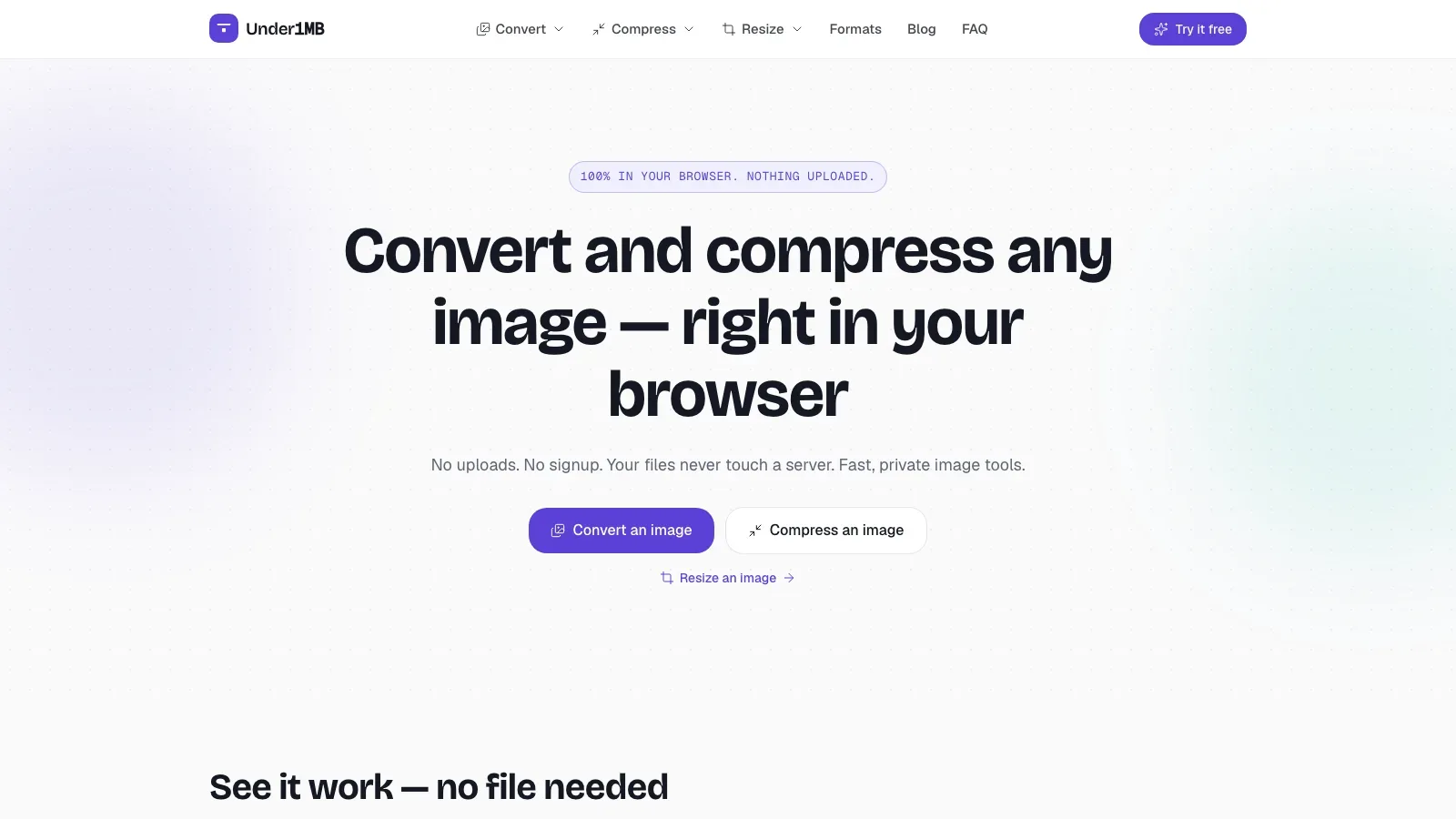
Under1MB is a free browser-based image converter and compressor built by Mohit Goyal in plain JavaScript: 11 formats, no uploads, no signup and no server. I built the product, the site and the branding myself, and launched it in public on LinkedIn. Most online image tools upload your files to a server, put a signup wall in front of the download and cap how many images you can process a day. For anyone who just needs a product photo under a size limit or a batch of screenshots converted, that is a lot of friction. It is also a privacy question they should not have to think about. I wanted a tool where the whole job happens on the user's own device, so there is nothing to upload, nothing to sign up for and no limit to enforce. Under1MB does exactly that. You drop a file, the browser decodes and re-encodes it, and the result is downloaded from memory. Nothing leaves the machine. It supports PNG, JPG, JFIF, WEBP, AVIF, GIF, BMP, ICO, HEIC, HEIF and SVG, so it covers the formats that come off phones and cameras as well as the ones the web wants. A target-size mode hits a chosen file size, such as under 1 MB. That is the use case the name comes from: upload forms and marketplaces that reject anything larger. Batch processing takes a folder of images and returns a ZIP, and a resize option handles the dimension side of the same problem. Every step runs locally, so large batches finish as fast as the device allows rather than waiting on a queue. The stack is deliberately plain: JavaScript, HTML and CSS, with no framework and no backend. Doing the encoding in the browser was the whole point. Keeping the app dependency-free keeps it fast to load and simple to maintain. The target-size mode works by iterating on quality until the output lands under the requested size. That is only practical because the encode loop runs on the user's hardware with no round trip. The absence of a server is also what makes the no-limit promise honest, since there is no cost per image for me to recover. I launched it in public on LinkedIn, where the launch post drew 45 reactions as reported on the post. The product is live at under1mb.app, and a Pro tier is planned. What I learned building it is that a strong constraint, in this case no server at all, makes product decisions easier. Every feature either works client-side or it does not ship, and that discipline produced a tool that is simpler than the alternatives it replaces. Have an idea for a small browser tool that respects its users? Send me the brief and I will reply with a plan.

JavaScript HTML CSS

WordPress plugin

HTTP Security Header WordPress Plugin

2024 – Present

HTTP Security Header is a WordPress.org plugin by Mohit Goyal in PHP that adds CSP, HSTS and security headers from a settings screen, now at 1,000+ installs. It exists so that site owners can pass a security header scan without editing server configuration they are rightly afraid to touch. Most WordPress sites fail security header scans. The fix is well known, but adding headers means editing .htaccess or the server config. Site owners will not touch that, and many agencies would rather not be responsible for it. The result is that sites stay exposed to clickjacking, content sniffing and cross-site scripting that a few response headers would mitigate. I wrote this plugin so that anyone can turn on the important headers from Settings > Security Headers, with sensible defaults and validation, and without a trip into the hosting panel. The plugin covers Strict-Transport-Security (HSTS), Content-Security-Policy (CSP), X-Frame-Options, X-Content-Type-Options, Referrer-Policy, Permissions-Policy, X-XSS-Protection, X-Permitted-Cross-Domain-Policies and Feature-Policy. Each header has its own settings with defaults that are safe to switch on, and the values are validated before they are saved. The part I care most about is the fallbacks. A bad Content-Security-Policy or a mistyped frame option cannot lock an admin out of their own site, because the plugin falls back to a working value rather than serving a header that breaks the dashboard. I published it to WordPress.org in November 2024 and have shipped updates through version 3.1. It is built in PHP for WordPress 5.0 and above. It sends headers from WordPress itself rather than from the web server, which makes it portable across Apache, Nginx and managed hosts where the owner has no config access. The settings screen uses the standard WordPress settings API, so it behaves like core and is easy to audit. Around the plugin I wrote a 15-article explainer series covering each header in turn. The series doubles as documentation and as the content that brings people to the plugin. I also built a companion online scanner on inspiredmonks.com that grades a site from A+ to F, so an owner can see the problem before installing the fix. At the time of writing the plugin reports more than 1,000 active installs, about 6,900 downloads and a 5 out of 5 rating on WordPress.org. Site owners who could never have edited a server file can now pass a header audit in a few minutes. Agencies I work with install it as a standard part of a build. The lesson from maintaining it has been that safe defaults and fallbacks matter more than coverage. A plugin that cannot break a site gets left switched on. Need a WordPress plugin built or hardened for your own site or product? Send me the requirements and I will reply with a plan.

PHP WordPress JavaScript WordPress.org

Agency website

Inspired Monks Development

2023 – Present

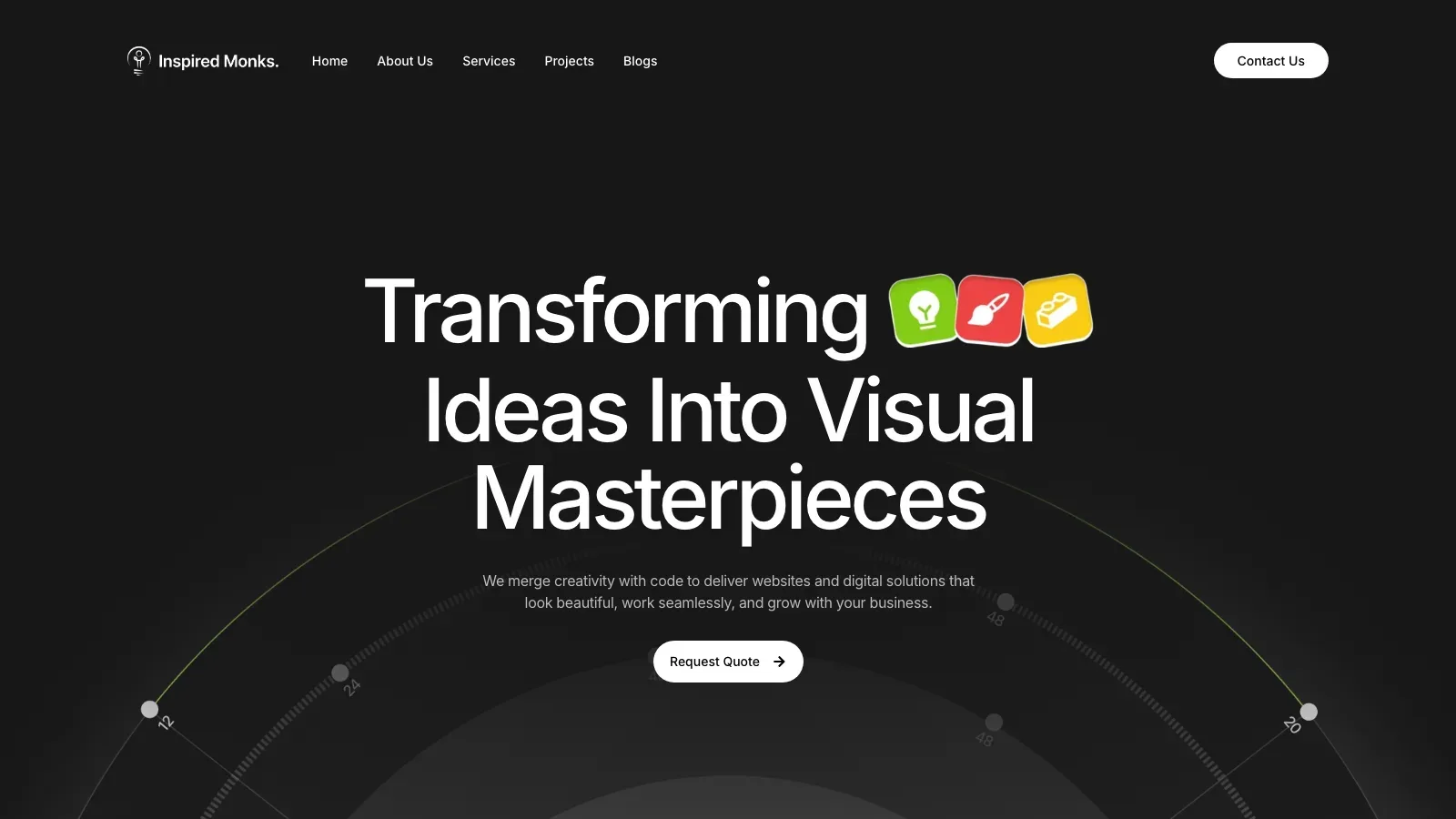
Inspired Monks is my freelance web development brand: a fast WordPress agency site built by Mohit Goyal with 75 blog posts, free tools and case studies. It serves clients across India, and it is both the storefront for my freelance practice and the testing ground where I prove the performance work I sell. The site has two jobs. The first is to win work. A prospect needs to see services, real case studies and evidence that the site itself is quick, because a slow agency site undermines every performance claim on it. The second is to be a laboratory. It is where I try caching strategies, header configurations and builder techniques on a real production site before using them on a client. The challenge in meeting both is that the site runs on Elementor, a page builder that is convenient for content but not naturally fast. The site is WordPress with Elementor, tuned for speed with lazy loading, image optimisation and custom caching logic. That gets it top Lighthouse performance scores despite the builder. Beyond the service pages it hosts case studies for Nortek LED, Orilite, IIID Inscape and CyberVie, each with deliverables, approach and outcomes. A client wall includes Janssen, IPL Biologicals, PropAlert, Taxocity, Aura Clips and Easy Parenting Hub. The blog holds 75 articles I have written on WordPress, Core Web Vitals, HTTP headers, SEO and freelancing. They are organised into categories such as web development, tips, HTTP headers, tools and WordPress plugins. The site also serves the free tools I built: the HTTP Security Header Scanner, the AI Proposal Generator, the Free Invoice Generator and Humora. Under1MB is linked from the footer alongside my WordPress plugins. The stack is WordPress, Elementor, PHP, JavaScript and Yoast SEO. Keeping Elementor was a deliberate choice, because the site is also where I write, and a builder makes publishing long-form content and tool landing pages quick. The performance cost is paid back with custom caching logic in PHP, lazy loading for images and embeds, and image optimisation at upload. That is the same recipe I apply to client sites. Yoast handles the on-page SEO for a content library this size. The free tools run as pages on the same install, so they share the hosting and the brand without separate deployments. The site is live at inspiredmonks.com and is where most of my freelance enquiries begin. I own every part of it: design, build, content and hosting. The most useful outcome has been the content and tools flywheel. The HTTP header articles bring readers to the scanner, the scanner points to the plugin, and the whole thing shows prospects that I can make a page builder site fast. Running an Elementor site that feels slow? Send me the URL and your goals and I will reply with a plan.

WordPress Elementor PHP JavaScript

Hospitality

Ravens Ait Venue Website

2025

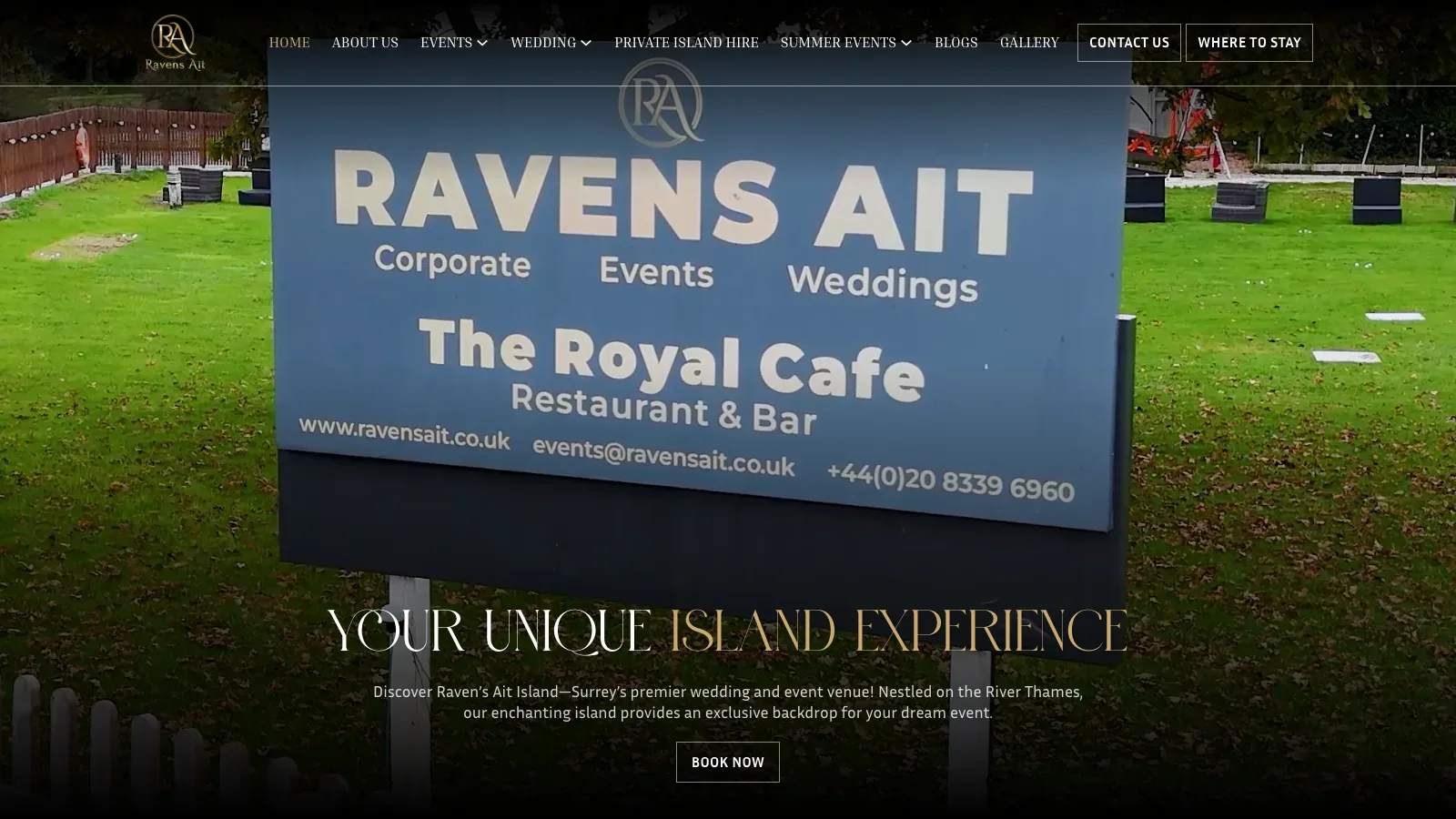
Ravens Ait venue website: WordPress and Bricks Builder build by Mohit Goyal for a Thames island venue, with 20+ event pages, Stripe bookings and HubSpot forms. It was built from scratch in 2025 through a London agency, scores 94 or higher on PageSpeed and has grown revenue pages since launch. Ravens Ait hosts weddings, christenings, private dining, corporate meetings and celebrations of life on a private island on the Thames near Kingston. The venue needed a site that reflected a luxury experience and converted browsers into enquiries. The brief asked for a luxurious light-gold palette, a sticky header, smooth non-intrusive animations, a quick availability call to action, an event-type carousel, an Instagram feed, case studies and testimonials. It also called for accessible contrast and a mobile-first layout. Working through a London agency, I built the full site from scratch on WordPress with Bricks Builder. The homepage has a video hero with Google-fetched reviews. There are nine event pages, including wedding sub-pages for Asian and European weddings, and eleven seasonal pages, from Holi to Boxing Day. All of them come from one Bricks template, so a new occasion is a content task rather than a build. Every event page follows one SEO heading structure: a single H1, three H2s for venue settings, catering and entertainment, H3s for FAQs, testimonials and the enquiry form, and an email subscription section. A gallery, blog templates with an author box, and a contact page with FAQs complete the core. Enquiry forms sync to HubSpot through Google Tag Manager, with mandatory fields so leads arrive complete. Later in 2025 I added revenue pages. A Wimbledon Tennis on the Island page has a date picker, per-date packages, Stripe payment through Forminator, customer and admin email templates, past dates disabled and a daily booking summary email. A Christmas 2025 page carries early-bird packages and a PDF flipbook menu. Dinner and Dance and Bollywood Student Night pages take Stripe bookings and share a combined promo popup. Bricks Builder was chosen over heavier builders because it produces lean markup. That is what made the PageSpeed target realistic on a page full of video and imagery. WP Rocket handles caching. The exit-intent popup is limited to once per 12 hours, with a scroll-triggered version on mobile, so it captures leaving visitors without nagging. HubSpot via Google Tag Manager keeps the CRM integration out of the theme code. Forminator with Stripe gave the venue paid bookings without a full e-commerce install. A cookie disclaimer and per-page SEO sections finished the build, followed by a QA pass that deduplicated card content and unified the sliders. The site has been live since April 2025 at ravensait.co.uk with a reported PageSpeed score of 94 or higher. The venue can now add a seasonal page or a ticketed event from templates, take payment on the page and see bookings summarised by email each day. The project taught me that one well-structured template, applied twenty times, is worth more than twenty bespoke pages. Run a venue that needs enquiry pages and ticketed events on one site? Send me your next project and I will reply with a plan.

WordPress Bricks Builder PHP Stripe

E-commerce

Whitfield Service Station Online Ordering

2025

WooCommerce online ordering for Whitfield Service Station in Dover, built by Mohit Goyal with a custom delivery radius plugin and cloud receipt printing. Three food brands on one forecourt now sell online for delivery and collection, and every order prints automatically in the kitchen. Whitfield Service Station is a forecourt in Dover that runs a Budgens store, a Fireaway pizza outlet and a doner and gyros kitchen. The owner wanted all three selling online without three separate systems. The catch was operational. Delivery had to stop at a sensible radius, fees had to reflect distance, orders had to reach the kitchen without staff watching a screen, and the store needed to switch ordering off when it closed. I built it on WordPress with Bricks Builder and WooCommerce. The shop has a three-brand landing with cards, per-brand category pages with a vertical category sidebar, a Budgens offers grid, combos, a My Account dashboard and a login and signup popup. Checkout is a multi-step Fluid Checkout with Stripe, Apple Pay and Google Pay. After the May 2025 feedback round I made the homepage e-commerce first, with dynamic featured, promotion and bestseller sections and brand cards with real product photography and Order Now buttons. I also audited the Fireaway and doner catalogues against their Just Eat menus. My custom Delivery Restriction Checker plugin geocodes the customer's address with the Google Maps API, hides delivery beyond 10 miles, charges a distance-based fee and falls back to pickup or dine-in. The delivery fee later became a flat fee, and cash on delivery was disabled. WooCommerce Product Add-Ons handle toppings and variations. A CSV import template with tutorial videos lets staff manage the menu. An 18+ confirmation covers alcohol and vapes, an opening-hours popup and WhatsApp float sit on the front end, and the owner can close the store or set hours from the admin. Food hygiene ratings and GDPR, privacy and terms pages round it out. The point-of-sale link is the piece that makes it work day to day. Orders print automatically to an Epson receipt printer through PrintNode, with order alerts in the WooCommerce mobile app, so the kitchen never has to check a dashboard. Writing the delivery logic as my own plugin rather than configuring a shipping extension was deliberate. The geocoding, radius and fee rules were specific enough that a bespoke plugin was smaller and easier to change than a general product, as the later switch to a flat fee showed. Bricks keeps the theme light, WP Rocket handles caching, and All in One SEO covers search. A W3C validation and performance report closed phase one in August 2025, with staff documentation covering price changes, reports, reprinting receipts, cancelling orders and hours. The platform is live at whitfieldservicestation.co.uk. The three outlets take online orders through one checkout, and staff manage the menu and the printer without a developer. The project confirmed that in food ordering the printer integration is the feature that decides whether the system gets used. Planning a similar online ordering store for a takeaway or forecourt? Send me your next project and I will reply with a plan.

WordPress WooCommerce Bricks Builder PHP

E-commerce

Wow Vastra Fashion Boutique Store

2025

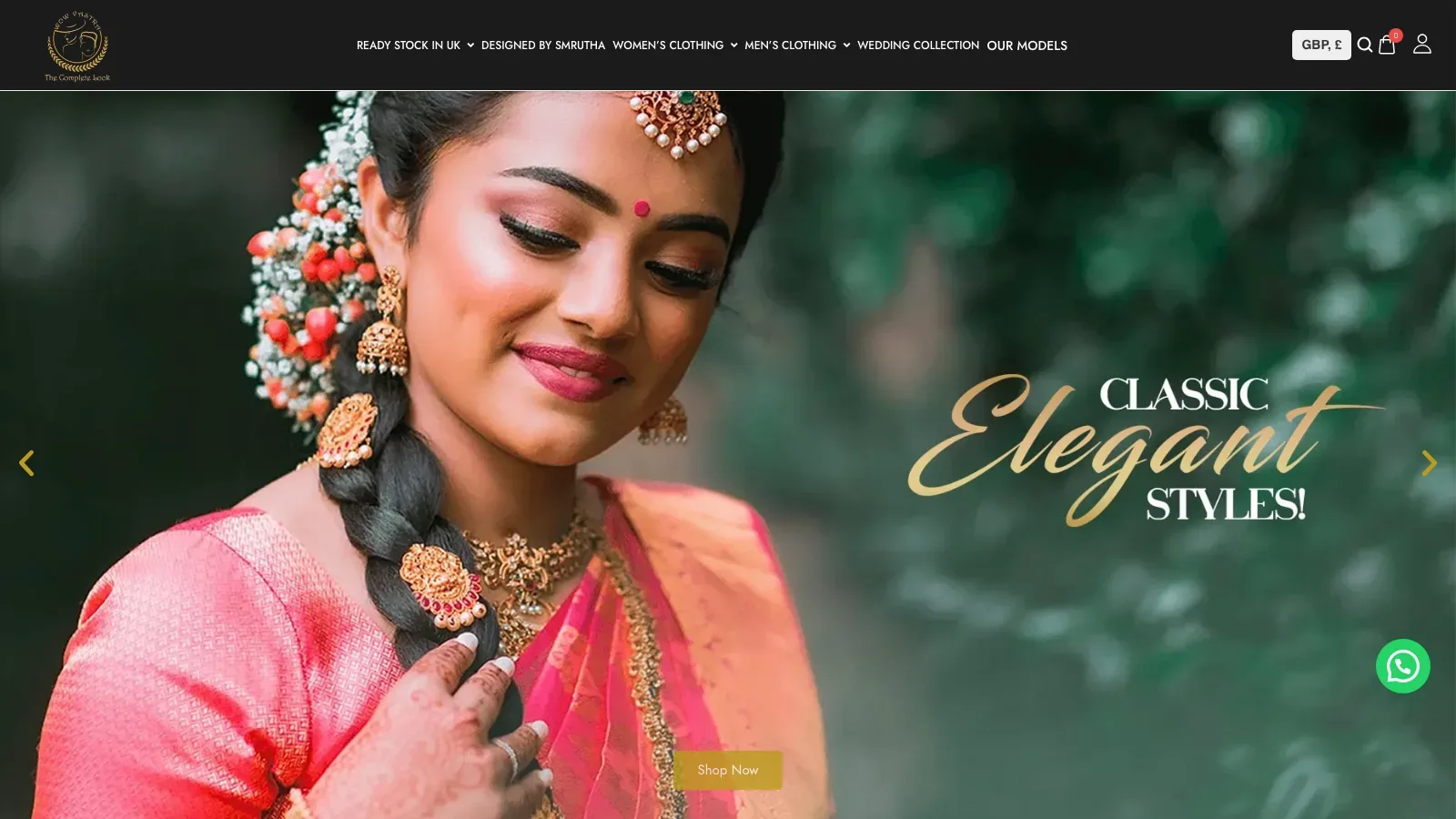
Wow Vastra WooCommerce development by Mohit Goyal for a UK Indian fashion boutique: new homepage, currency switcher, worldwide checkout and a 1.5 second load. The work was done on the client's purchased theme, without a rebuild, through a London agency in 2025. Wow Vastra sells sarees, lehengas and Indian occasion wear from the UK to customers worldwide, on a WooCommerce store built on a purchased theme. The owner wanted a stronger homepage that sold the collections rather than listing them. She also needed a checkout that worked for international buyers who pay in dollars, euros or rupees and have addresses that do not fit a UK postcode form. The constraint was to improve the store without replacing the theme, so every change had to live alongside the theme's own templates. In April 2025 I launched a new homepage. It has eight category banners mapped to filtered shop URLs, separate desktop and mobile banner sets, an Our Fashion Shows section, testimonials and social links. A redesign pass then switched to larger rectangular product cards with a Buy Now button under each name. It resized the banner sets, replaced the models section with four Instagram reels and added detailed photo testimonials. Tighter spacing and one slide per section on mobile make the page scroll cleanly on a phone. On the shop side I added a GBP, USD, EUR and INR currency switcher driven by a live exchange-rate API, a free-format worldwide address at checkout and a worldwide shipping notice in the header. Product variations became dropdowns with per-category attributes for blouse stitching, pre-stitched sarees, fall and pico and petticoats. Listings show the minimum variation price, and a styling-suggestions block offers items bought together. Performance work moved asset loading into the theme and added caching, bringing the desktop homepage to about 1.5 seconds as measured after the change. Working with a purchased theme meant choosing extensions that cooperate with it. I used a premium currency switcher plugin for the exchange rates and WooCommerce's own variation system for the stitching options rather than custom code. Elementor handles the homepage so the owner can edit banners without me. I also fixed category page meta titles and descriptions. I de-indexed the staging site so it could not compete with the live store in search. Along the way I diagnosed a server outage and wrote a handover document in May 2025. The store is live at wowvastra.com. International customers can now browse in their own currency and check out with their own address format, and the owner can swap banners and reels from the homepage without a developer. The project was a good reminder that most of the value in a store refresh comes from the shop mechanics, currency, address and variations, rather than from the visual redesign that prompts the brief. Selling to customers abroad from a WooCommerce store? Tell me what is holding your checkout back and I will reply with a plan.

WordPress WooCommerce Elementor PHP

Hospitality

Crowne Plaza London Kingston Hotel Website

2025

Crowne Plaza London Kingston hotel website rebuilt by Mohit Goyal on WordPress and Elementor, with rooms linked to IHG booking, meeting forms and promo popups. The rebuild replaced a broken Elementor site in June 2025 and has been extended since, delivered through a London agency. The hotel's existing site had a broken homepage layout and a heavy loader that delayed every visit. Rooms were not presented in a way that led to a booking, meeting enquiries had no clear path, and the site lacked the basic pages a hotel needs for privacy and cookies. After a quick repair of the homepage in April 2025, the agency and the hotel agreed a proper rebuild rather than more patching. In June 2025 I rebuilt the site on staging. I removed the loader and smooth-scroll scripts that were slowing the pages. Then I built a grid of eight rooms with hover amenity icons, each linking to IHG booking in a new tab so the hotel's reservation system stays the source of truth. A meeting rooms grid uses venue-specific dropdown forms, so an enquiry arrives already tagged with the right space. I added an FAQ, privacy and cookie pages, and enquiry forms routed to the hotel inbox. Highlighted amenities include the gym, EV charging, river views, the restaurant, IHG One Rewards and parking. I handled responsive layout, 404 redirects, index settings and SEO titles, and the new site went live on 17 June 2025. Over the following months I added a blog listing with the first post and promo popups the hotel can switch on for seasonal offers. Staying on WordPress and Elementor was the right call for a hotel whose team needed to edit content themselves. The gains came from removing scripts rather than adding them. Linking rooms to IHG instead of building a booking engine kept the site honest about where availability lives. In July I diagnosed a GoDaddy cache layer that was swallowing form submissions. It looked like a form bug but was the host's optimisation layer, and upgrading PHP from 8.0 to 8.3 fixed it. Yoast-style SEO titles and clean redirects protected the rankings the old site already had. Delivered as a freelance project through a London agency, the site is live at cplondonkingston.co.uk. The hotel can now switch a promotion on with a popup, publish a post and take a meeting enquiry without a developer, and every room leads straight to a booking. The main lesson was in the form fix: when submissions vanish, check the hosting layer before the plugin. Does your hotel website need a rebuild that keeps bookings flowing to your reservation system? Send me the details and I will reply with a plan.

WordPress Elementor PHP GoDaddy

Agency website

Aura Clips Agency Website

2025

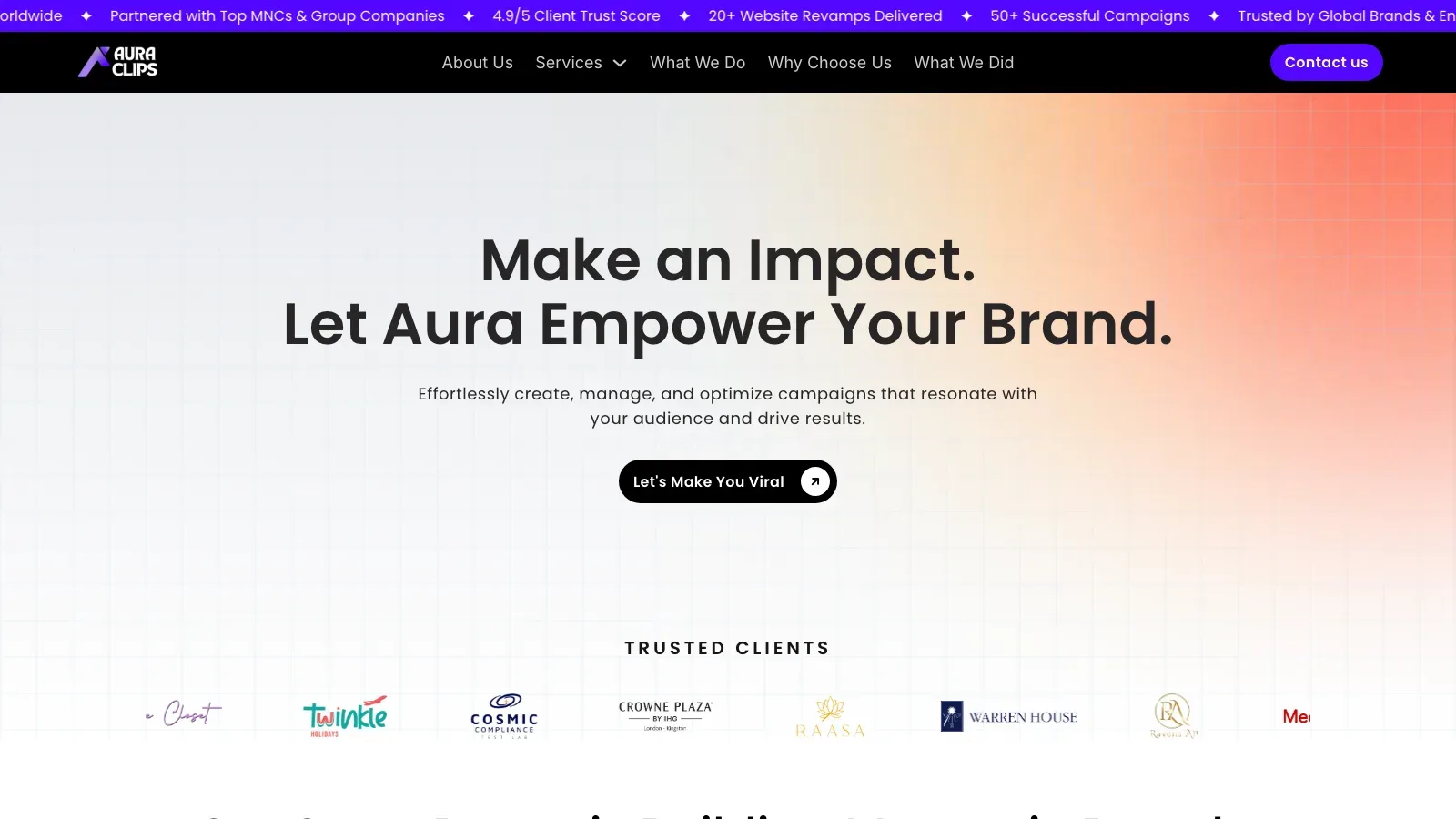
Aura Clips agency website: Framer to WordPress rebuild of auraclips.com by Mohit Goyal on Bricks Builder, with service templates, a blog, GA4 and Tag Manager. It is the London agency's own storefront, and it showcases the hospitality and e-commerce sites I delivered through them in 2025. Their own site was on Framer, which made content changes and SEO harder than they needed to be. Every edit went through a designer, blog posts were awkward, and the technical SEO controls the agency sells to clients were not available on its own site. They wanted a site they could edit, extend with case studies and rank, built on the same WordPress foundation they recommend to clients. Between June and August 2025 I rebuilt it on WordPress with Bricks Builder, having made the case for Bricks over Elementor for a cleaner, faster build. The homepage has a running-line marquee, a hero with a scrolling client logo strip, services, a why-us section, testimonials, an FAQ and a footer. I built the case-study section with cards for Ravens Ait, Warren House, Whitfield Service Station and executive branding, plus an articles grid fed from the blog. The contact form has a service dropdown covering SEO, ads, LinkedIn, digital PR and website development, so enquiries arrive sorted by service. The About page carries a history timeline, the Services page links to five single-service pages built from one template, and there is a blog with a single post template. Inter is the typeface, with fade-in effects on scroll. Bricks was the central technical decision. It outputs lean, class-based markup, which keeps the pages fast without a caching arms race and makes the templates reusable. A sixth service page is a content entry rather than a layout job. The blog and case studies are standard WordPress post types, which is what gives the agency the editing and SEO control Framer lacked. Launch work included moving the domain to www, setting up Google Search Console, GA4 analytics and Google Tag Manager, writing meta titles and fixing indexing issues so the new site replaced the old one in search cleanly. A content pass and header dropdowns followed in August 2025. The site is live at auraclips.com. The agency can now publish articles, add a case study and track conversions in GA4 without outside help. The case-study section does double duty as a portfolio for the work I built with them. The project was a useful proof that a well-structured Bricks build can give a small agency the control of a custom site without the maintenance burden of one. Moving an agency site from Framer, Webflow or Wix to WordPress? Send me the current URL and I will reply with a plan.

WordPress Bricks Builder PHP Google Search Console

Corporate website

Samko Holdings Corporate Website

2025

Samko Holdings corporate website on WordPress and Elementor Pro, built by Mohit Goyal for a UK hospitality, energy and restaurant group and made responsive. It is the group site that sits above several of the hotels, venues and restaurants I worked on in 2025. In March 2025 the group had an Elementor Pro build that was not responsive. It was also missing the pages a corporate site needs to explain who runs the company and what its divisions do. The goal was a finished, mobile-ready site with leadership, history and division pages, working contact and newsletter forms, and a move from staging to the group's own hosting. I took the existing build, made its 12 pages fully responsive and added the missing pieces. These were a leadership page with chairman and chief financial officer designations, history, mission and vision, division pages for hospitality, energy, leisure and restaurants with an energy slider, a careers page, and a contact page with forms and a newsletter signup wired to the group inbox. The page set covers home, about, history, leadership, mission and vision, an overview of the group, the four division pages, careers and contact. Navigation is a mega menu. The site carries Yoast SEO, Wordfence and WP Activity Log, with an exit popup to capture leaving visitors. I hid an unfinished insights page until the group has content for it. The stack is Elementor Pro with its theme builder for the header and footer templates, PHP, Yoast SEO and GoDaddy. Keeping the Elementor Pro build rather than restarting was the pragmatic choice, because the design was approved and only the engineering was missing. I migrated the site from staging to GoDaddy hosting on 24 and 25 March 2025. Measured after launch, PageSpeed Insights scored 96 on desktop and 90 on mobile, and I delivered GTmetrix reports alongside. The handover documents the design system: a gold palette with Inria typography on a 12-column grid, a fixed shrinking navigation, and fade-in hero and card hover effects. It also covers how to edit templates, pages, services, redirects and form leads. In July 2025 form submissions started failing. I traced it to GoDaddy's Airo Plus cache and resolved it by upgrading PHP from 8.0 to 8.3, the same fix I later applied on a sister hotel site. I also produced a full site backup and export for the client in May 2025. This was a freelance project through a London agency, live at samkoholding.com. The group now has a responsive corporate site it can edit from documented templates, with leads and newsletter signups arriving in its inbox and a measured performance baseline to hold future changes against. The GoDaddy cache incident became a reusable diagnosis for the group's other sites. Have a half-finished corporate site that needs completing and launching? Send me the staging link and I will reply with a plan.
WordPress Elementor Pro Yoast SEO PHP

Hospitality

Warren House Hotel Homepage

2025

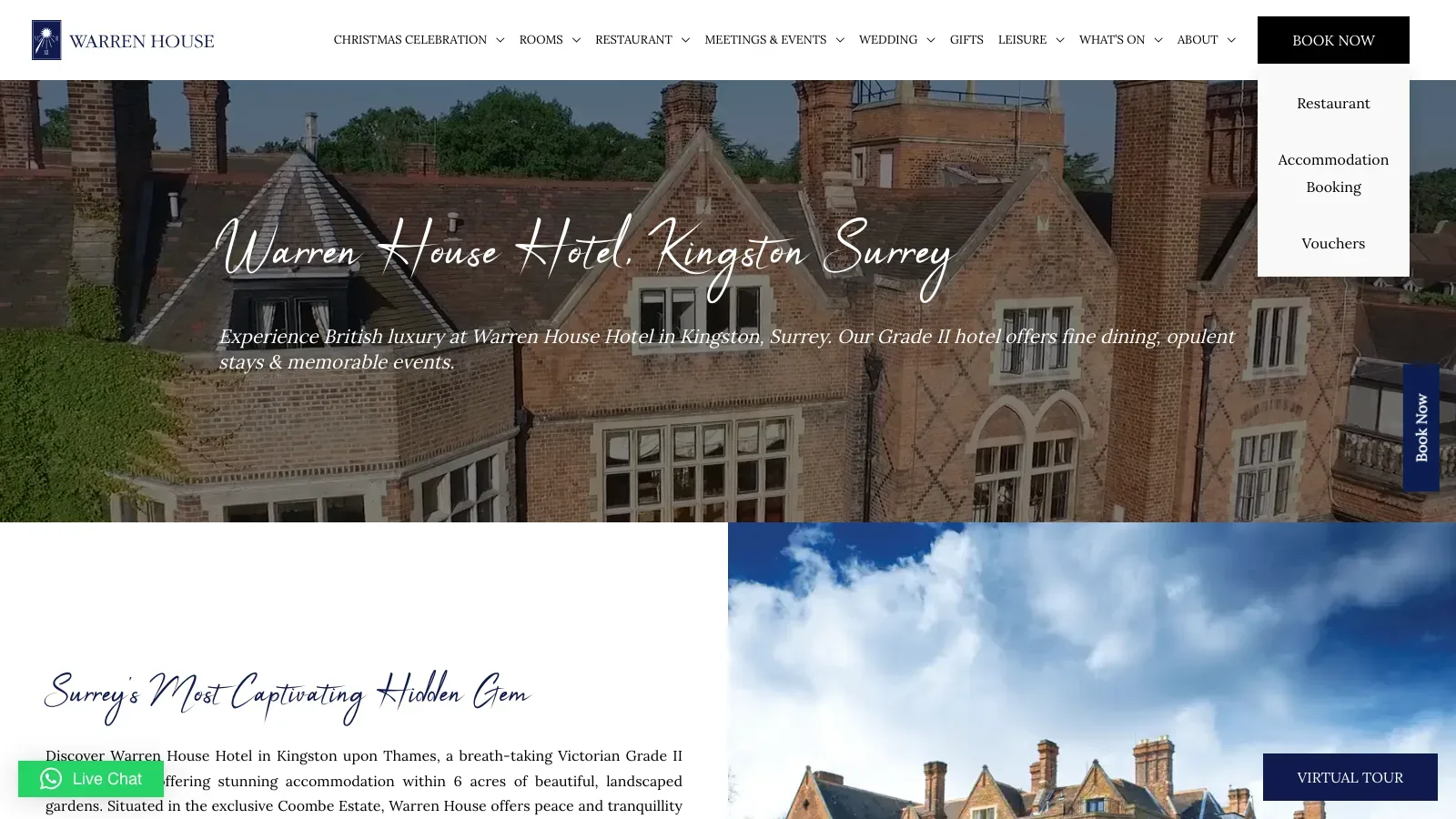
Warren House homepage: new Elementor Pro homepage by Mohit Goyal for a Kingston hotel and wedding venue, with video hero, rooms first and Google reviews. The work replaced the entry point of an existing WordPress site rather than rebuilding it, and was delivered through a London agency in 2025. Warren House is a country-house hotel and wedding venue in Kingston upon Thames. Its WordPress site worked, but the homepage did not present the hotel the way high-end venue sites do. Rooms were buried below marketing content, and a HubSpot popup the marketing team relied on was not firing. A full redesign had been discussed. The brief was to deliver the homepage and the fixes that mattered now without committing to the wider project. In July 2025 I added a blog listing and first post to the existing site and diagnosed the HubSpot popup that was not firing. In September I built a new homepage on Elementor Pro. It has a full-width video hero, subtle scroll animations in the style of high-end hotel sites, and rooms placed first in the page order so the booking path is immediate. Reviews are fetched from Google so social proof stays current without manual updates. A new header and footer are responsive across breakpoints. I also built a Wedding Fair popup that appears after five seconds to promote the event, and fixed a legacy popup whose close button did not work, which had been quietly frustrating visitors. Elementor Pro was the existing platform, and building the homepage there meant the hotel's team could keep editing with the tools they knew. The animations were kept subtle and scroll-linked so they add polish without hurting load time on a page that opens with video. Pulling reviews from Google rather than pasting quotes avoids a page that goes stale. HubSpot stayed as the popup and lead tool because the hotel's marketing already ran through it. Fixing the existing popups was cheaper than replacing them. A 24-page site plan was scoped and quoted, with the wider redesign currently on hold, so this project covers the homepage and supporting fixes rather than a full rebuild. It was a freelance project through a London agency, and the homepage is live at warrenhouse.com. The hotel now has a front page that leads with rooms and reviews, a working popup programme for events like the wedding fair, and a blog it can publish to. The project showed me that a homepage and a few well-chosen fixes can deliver most of the visible benefit of a redesign while the larger decision waits. Need a hotel or venue homepage that leads with rooms and reviews? Send me your site and I will reply with a plan.
WordPress Elementor Pro PHP HubSpot

Hospitality

Raasa Restaurant Landing Page

2025

Raasa Restaurant landing page: a coming-soon site for a Locksbottom Indian restaurant, built overnight by Mohit Goyal on WordPress and Elementor and put live. It turned a mismatched theme demo into a clean launch page before the restaurant opened. Raasa is an Indian restaurant in Locksbottom, Orpington. It needed a presence online before opening so that early customers could find it, read about the kitchen and leave an email address. The agency had a horizontal-scroll theme demo that did not fit a restaurant, and the deadline was the next morning. The brief was simple but tight: one page, live on the real domain, by the time the client checked in. On 8 and 9 April 2025 I converted the demo into a one-page landing. It has a hero, an About Raasa section with the head chef's biography, a menu teaser, an email sign-up and a map. Converting the demo meant fixing the theme breakage that came with removing its horizontal scroll. I stripped the sections that did not apply and rebuilt the remaining ones as a vertical page. I also removed the unused WooCommerce install the demo had brought along. It had no place on a coming-soon page and only added weight and attack surface. The same night I migrated the page from staging to the live domain, so the restaurant woke up with a working site on its own address. Elementor was the right tool for a page that had to exist by morning and that the agency would edit later. Keeping WordPress rather than a static page meant the site could grow into a full restaurant site, with menus and bookings, without migrating again. Removing WooCommerce and the unused theme parts kept the page light. That matters for a site most people open on a phone while deciding where to eat. Later in 2025 I installed Google Tag Manager so the agency could add analytics and tracking without further code changes. I added opening hours to the footer once the restaurant had fixed them. The page is live at raasarestaurant.co.uk. The restaurant had an online presence before opening day, collected sign-ups from the start and now has a WordPress base that can be extended as the business grows. It was a small project, but a good example of turning a mismatched theme into a clean launch page under time pressure. Knowing what to delete is often the fastest route to a finished site. Opening a restaurant and need a launch page by a fixed date? Tell me the date and I will reply with a plan.

WordPress Elementor PHP Google Tag Manager

Hospitality

Cyprianis Restaurant Website Revamp

2025

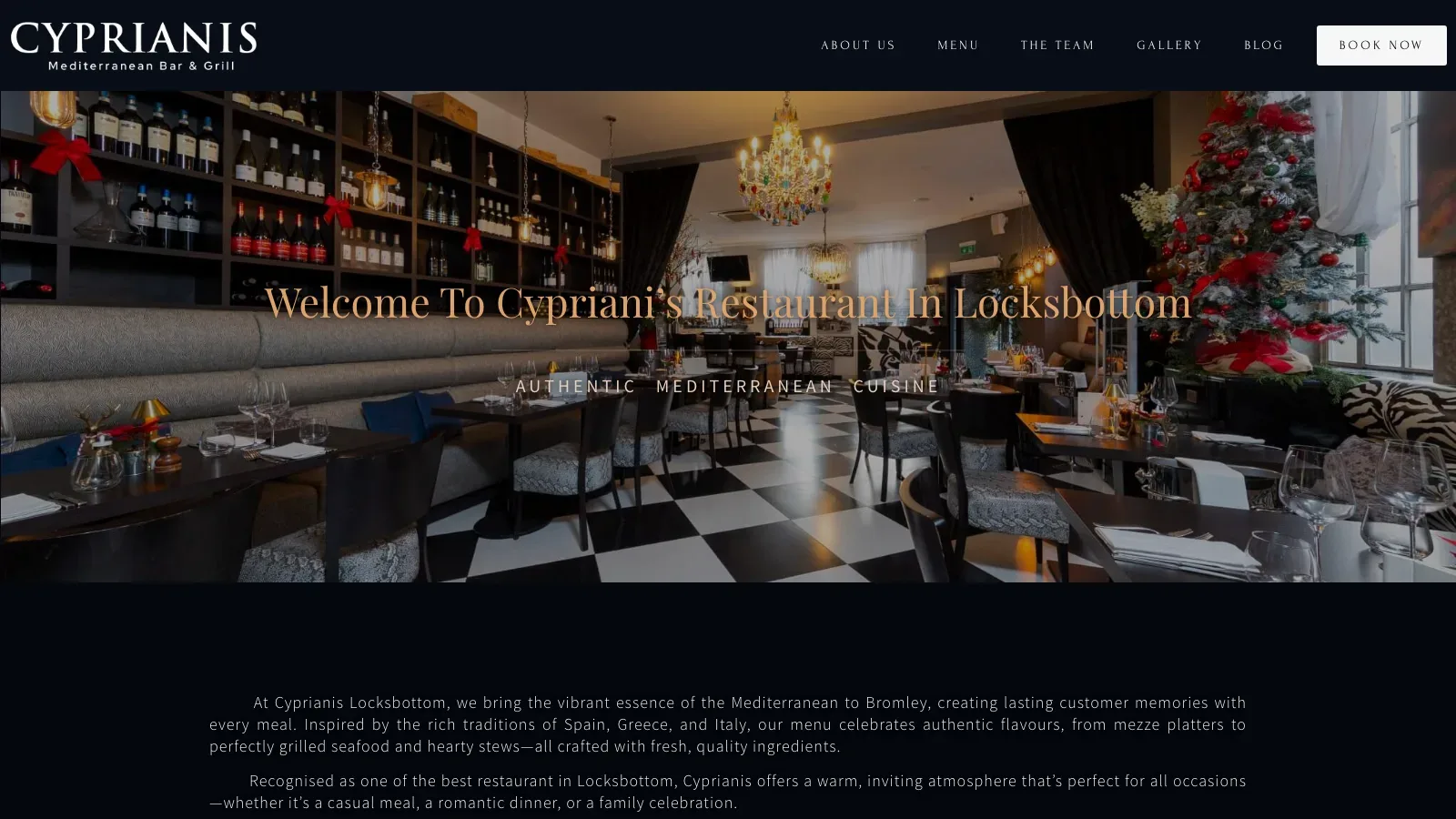
Cyprianis restaurant website revamp by Mohit Goyal: new Elementor homepage, events listing and private dining template from Figma for a Locksbottom restaurant. The work updated the look of a working Italian restaurant site without replacing it, through a London agency in September 2025. Cyprianis had a working Elementor site that no longer matched how the restaurant wanted to present itself. The agency supplied a Figma design for the refresh, covering a new homepage, a way to promote events and a page for private dining enquiries. The constraint was to deliver the new look without a rebuild. The existing WordPress install, plugins and URLs had to stay, so nothing broke for the client or for search, and the cost and timeline had to suit a small restaurant. In September 2025 I built a new homepage from the Figma design on Elementor, an Events listing, and a single event template used for private dining. I integrated the menu so diners can see what is on before they book. Every page was made fully responsive and checked against the Figma at desktop and mobile breakpoints. The new homepage was swapped in only once it matched, so the live site never showed a half-finished state. The events listing and single template give the restaurant a repeatable way to announce a supper club or a seasonal evening without a new build each time. Revamping in place rather than rebuilding was the central decision. It kept the plugins, settings and URLs the restaurant already relied on, which protected its search presence and avoided a migration. Elementor was already installed and the agency's team knows it, so new pages fit the existing workflow. Working from Figma meant the layout decisions were already made. My job was a faithful, responsive implementation, which is where a page builder earns its keep. Building the new homepage alongside the old one and switching at the end is a small habit that removes most of the risk from a refresh. It was a freelance project through a London agency, live at cyprianislocksbottom.co.uk. The restaurant has a homepage that reflects its current positioning, an events section it can update itself and a private dining page that turns interest into enquiries. Revamping in place kept the cost low and the launch quick, which is often the right call for a small restaurant site. This project is the example I point to when a client assumes a new look requires a new site. Have a Figma design that needs a faithful WordPress build on an existing site? Send me the file and I will reply with a plan.
WordPress Elementor PHP Figma

Corporate website

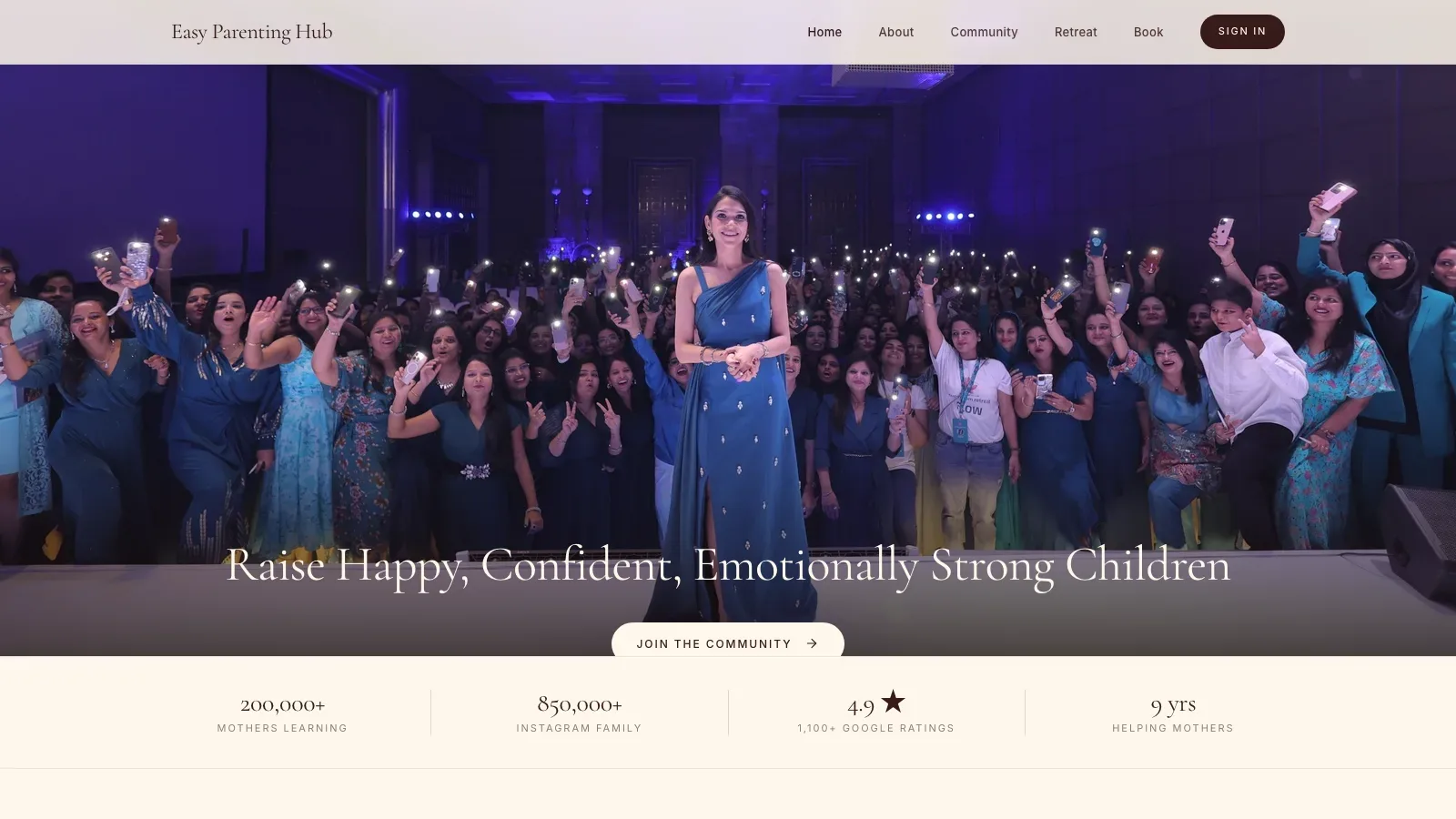
Easy Parenting Hub Community Website

2025 – 2026

Easy Parenting Hub is a WordPress community website for a parenting coach, built by Mohit Goyal on Elementor with a Community Hub, retreat videos and forms. One site now serves both the community brand and the coach's personal brand after consolidating two older sites. The old sites were split across Webflow and WordPress, so content, leads and branding were scattered across two platforms with different editing tools. The goal was a single WordPress site that serves two domains, easyparentinghub.com and the coach's personal brand site, riddhideorah.com. It needed a community section, the retreats and book, and a reliable way to capture enquiries. The first demo had a one-week target. I built the site on the Coaching WP theme with Elementor. It is styled after a ThimPress life-coaching reference, with the Exo 2 font, a lotus logo and the brand pink applied throughout. The demo was ready in two days against the one-week target, staged on an Inspired Monks subdomain. I then refined it section by section from the client's desktop and mobile structure documents across feedback rounds from August to November 2025. The Home page has an auto-rotating slider, Google ratings, years-of-experience stats and a news ticker. About holds achievements in three buckets, a mentors grid and a My Book section. Super Mom Retreat embeds YouTube and Vimeo videos from the book launch and the Bangalore and Delhi retreats. The Community Hub opens with a Find Your Tribe call to action. Other calls to action were reworded in the feedback rounds. A Get in touch button opens a Contact Form 7 form. Submissions are emailed automatically, so every lead arrives in the same format. Community photos were resized for mobile and the mobile logo enlarged after the first review. Using a purchased theme was the technical decision that made the one-week target realistic. Elementor sits on top so the client can edit sections herself. Contact Form 7 was chosen for the form because its email templates let me standardise the lead data without a CRM. The Instagram feed runs through the Instagram API with a token I reconfigured after the move. I took the site live on 6 November 2025 by migrating it onto the client's Hostinger server with PHP 8.3. In March 2026 I removed a junk-lead button and added spam protection on both domains after tracing the source of the junk. The site is live at easyparentinghub.com. The coach now runs both brands from one WordPress admin, every enquiry arrives by email in a consistent format, and the retreat and community content lives in sections she can update. The lesson was that a theme-based build with a fast demo and structured feedback rounds gets a small brand live quickly without sacrificing a design it is proud of. Are you a coach or creator running two brands from two sites? Send me both links and I will reply with a plan to bring them together.

WordPress Elementor PHP Instagram API

Corporate website

Taxocity Tax Services Website

2025

Taxocity tax services website: custom WordPress on Bricks Builder, built by Mohit Goyal for a tax and compliance firm, with every lead saved to a Google Sheet. Built in August 2025 from a Figma draft, the site lists the firm's services and turns paid ad traffic into a lead list its CRM reads from. Taxocity helps businesses with GST filing, taxation, company registration and related compliance work, and promises to simplify legal, tax and compliance for business. The firm runs paid ad campaigns that send prospects to the site. It needed pages that list those services clearly, explain each one in plain terms and convert that traffic into enquiries. The sales process was the real requirement. The team wanted to follow up on every enquiry fast and keep a record of who asked about what, without anyone logging into WordPress to find form submissions. I built it in August 2025 as a custom WordPress site on Bricks Builder under my Inspired Monks brand, working from a Figma UI draft. The services structure gives each offering its own page. GST filing, taxation and company registration each have a URL that can rank for its own terms and a clear call to action that leads to the form. A 30-day money-back guarantee badge and message lower the risk of a first enquiry. There is a contact page template, and a Book a Consultation page was prepared but kept unpublished until the client was ready to take bookings. The layout is responsive and tuned for the phones most of the firm's visitors use. The important piece is lead handling. Every Bricks form submission is written to a Google Sheet as it arrives, so the Taxocity team has one running list of prospects with the service they asked about. That sheet is what their CRM reads from, so follow-up and selling happen from a live list. I also handled the on-page SEO basics, performance and security hardening. Bricks Builder was chosen because a services firm needs many similar pages that load quickly on mobile. Bricks produces lean markup from one template, so each new service page is a content task. PHP handles the hook that pushes form submissions to Google Sheets. I evaluated a direct TeleCRM webhook and a Forminator-based form migration as alternatives. I settled on the sheet as the integration point because the team already works in Google Sheets, the CRM could read from it, and a sheet can be sorted, filtered and shared with whoever is on follow-up that week. Security hardening on a WordPress site that collects business enquiries is not optional, so the build includes the header and access measures I apply as standard. It was a freelance project through Inspired Monks, live at taxocity.com, and the firm appears on the Inspired Monks client wall. The team can now see every enquiry from its ad campaigns in one sheet with the service it relates to, follow up the same day and let the CRM pick it up from there. Each service has a page that can be found in search on its own. The project is a good example of fitting the lead pipeline to how a client already works rather than to what a developer would prefer. Running ads to a services site that loses leads in an inbox? Send me your next project and I will reply with a plan.
WordPress Bricks Builder PHP Google Sheets

Corporate website

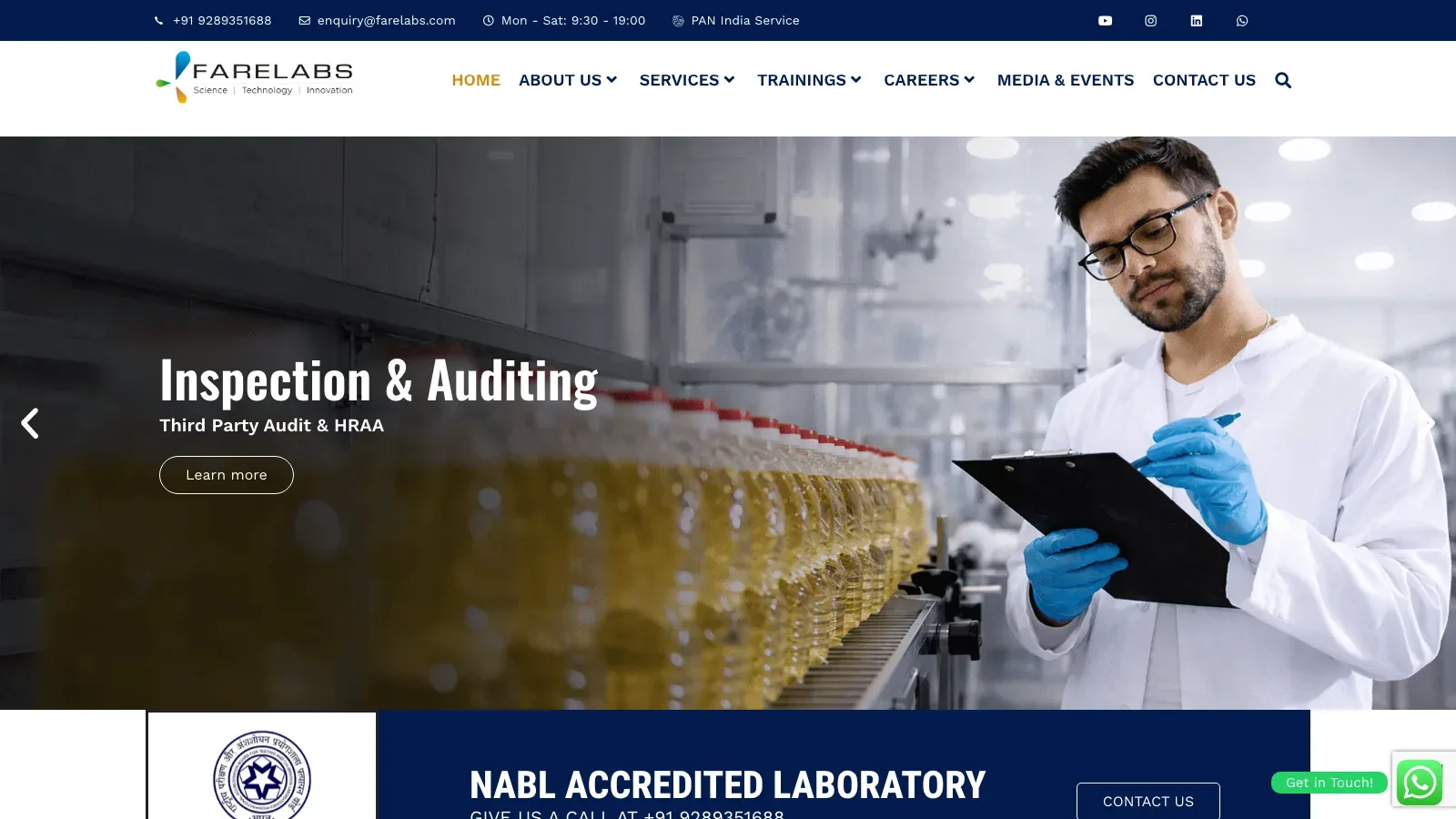
FARE Labs Company Website

2023 – 2024

FARE Labs company website and landing pages on WordPress and Elementor, built and maintained by Mohit Goyal as the lab's in-house developer and team lead. This was not a freelance job. From March 2023 to April 2024 I worked full-time at FARE Labs in Gurugram. I owned farelabs.com and everything the marketing team needed online, from the main company site to the pages and assets behind its email and social media campaigns. FARE Labs is a testing and calibration lab. Its website had to explain a technical set of services, testing, calibration and certification, to customers who arrive from a search result or a campaign link. It had to do that on a phone as reliably as on a desktop. The marketing team also needed new landing pages on a regular cadence for campaigns and service launches, with forms that reached the sales team without delay. The goal was a site that stayed fast, consistent across browsers and easy to extend as new services and campaigns came up. I built and maintained the responsive company site on WordPress with Elementor, covering the lab's testing, calibration and certification services. I kept it consistent across browsers and fast on mobile. Alongside the main site I produced marketing landing pages for campaigns and service launches, each with forms wired to the sales team so enquiries landed with the right people. I supported the company's email and social media campaigns by building the pages and assets they pointed to. A campaign could go out knowing the destination page matched the message. The stack was WordPress and Elementor, with HTML, CSS, JavaScript and PHP customisation on top of the Elementor build wherever the page builder stopped short. I chose to stay on Elementor rather than rebuild from scratch because the marketing team already knew it and could make routine edits themselves. That kept my time for the work that needed code: performance tuning, custom layouts, form behaviour and the on-page SEO work that a lab site depends on for service queries. As team lead I also coordinated the small web team so requests from marketing moved through in order. The outcome was a company site and a steady stream of campaign landing pages that the marketing team could rely on, served fast on mobile and consistent in every browser I tested. No performance or traffic metrics were measured for this work. The team could launch a campaign with a matching landing page and a working form, and the services content stayed current without waiting on an agency. The site is live at farelabs.com. Need an in-house style developer for a company site and its campaign pages, without the hire? Send me the details and I will reply with a plan.

WordPress Elementor PHP JavaScript

Hospitality

Magpie Retreat Website

2023

Magpie Retreat website repair: UX fixes, image enhancement and a rebuilt Elementor header by Mohit Goyal for a retreat in Uttarakhand, done in March 2023. It was a repair rather than a rebuild. The same WordPress site was cleaned up in a few days so it finally did the place justice. Magpie Retreat had a WordPress site on Elementor that worked but undersold the retreat. Layouts were inconsistent from page to page. The imagery was low quality for a business whose main selling point is its setting. The header broke on smaller screens, which is where most of its visitors arrive. The client did not want a new site; they wanted this one to look right and behave on phones. The goal was a short, contained engagement that fixed what was wrong without introducing anything new to maintain. I went through the pages fixing UI and UX issues one by one: spacing, alignment, button states and mobile layouts, so each page read consistently with the next. I enhanced and re-exported the images so the retreat's photography looked sharp without slowing the site, balancing quality against file size on every image. I rebuilt the header in Elementor with a navigation that behaves on phones, replacing the one that broke on small screens. The result was the same site, cleaner and faster to browse. The stack was WordPress, Elementor and CSS, plus image optimisation. I kept the work inside Elementor rather than replacing the builder. The client already managed the site there, and a change of tooling would have cost more than it saved. CSS covered the fixes the builder could not express, such as consistent button states and mobile spacing. For the images I re-exported from the originals at the right dimensions and compression rather than running a blanket optimiser. The photography was the point of the site and had to stay sharp. The outcome was a site that presented the retreat properly, with a header that works on phones and pages that load faster than before. No metrics were measured for this work. The client can keep managing the site in Elementor exactly as before, with the layout and imagery problems gone. It was a freelance project for a client in Uttarakhand, and the site is live at magpie-retreat.com. Is your site working but not doing your business justice on mobile? Send me the link and I will reply with a short fix list.

WordPress Elementor CSS Image optimisation

E-commerce

Nortek Lighting E-Commerce

2023

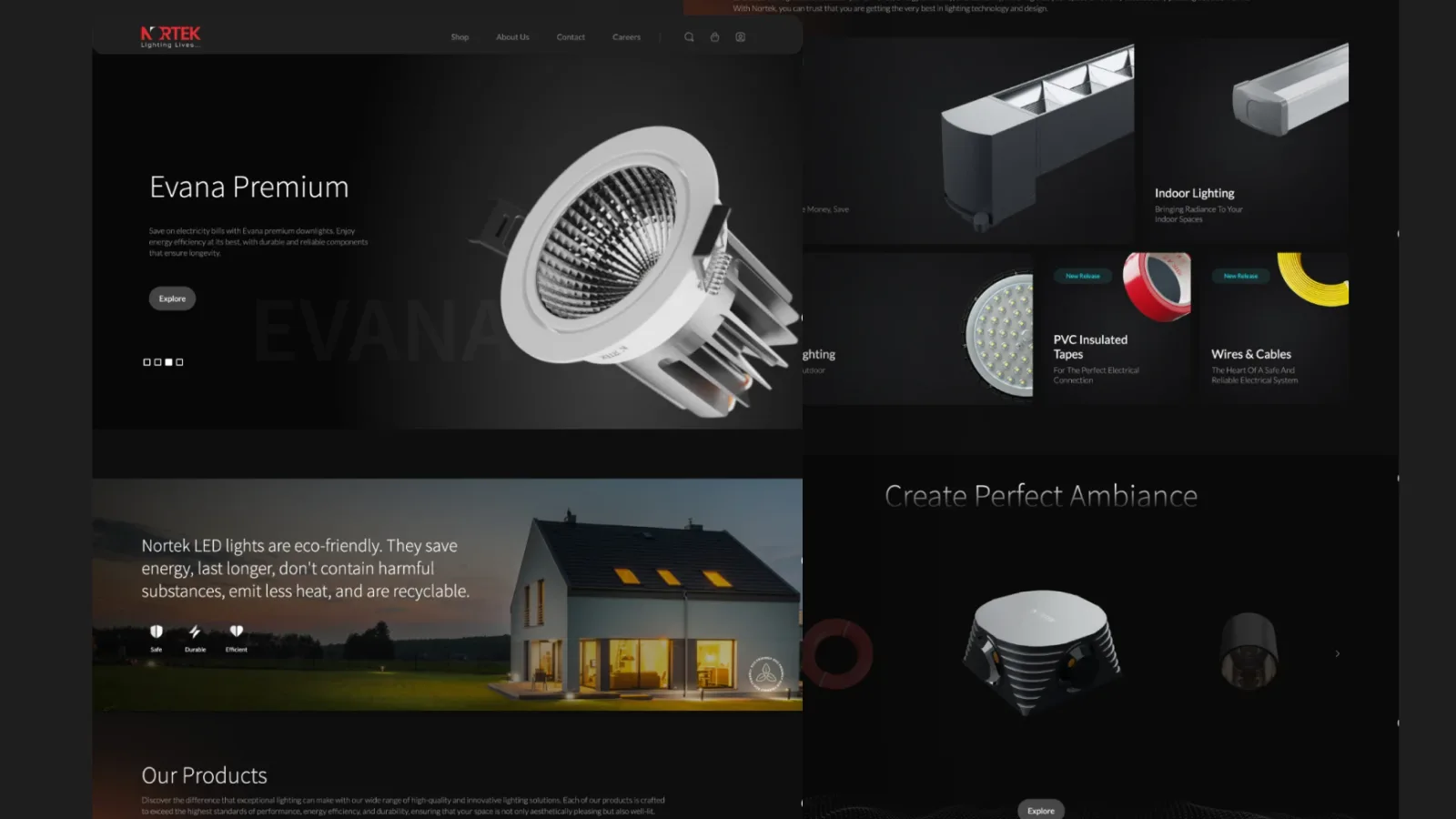
Nortek LED WooCommerce store built pixel-perfect from Figma by Mohit Goyal on a custom Oxygen Builder theme, with product filters and an optimised checkout. Nortek LED sells LED drivers, panels, downlights, strip and outdoor lights plus wires and tapes. The store had to make that large catalogue easy to browse and buy from on any device. Nortek came with a finished Figma design and a catalogue that was wide rather than deep: many product families, each with its own attributes, and customers who know what they need but have to find it fast. Their goal was a store that matched the design exactly, let shoppers narrow the catalogue by the attributes that matter for lighting, and took them through checkout with as little friction as possible. The engagement ran from April to October 2023 as a freelance project. I ran design review sessions to settle the user flows before building. I then built a custom WordPress theme in Oxygen Builder with Advanced Custom Fields (ACF) and custom post type templates for dynamic product pages, so each product type could show the specifications that matter for it. WooCommerce was configured with tailored attribute filters for browsing the catalogue and checkout changes aimed at conversions. Around the build I handled image optimisation, caching, SSL and WordPress hardening, cross-browser QA, analytics setup and accessibility fixes. Admin training and documentation let the client's team run the store. The stack was WordPress, WooCommerce, Oxygen Builder, Advanced Custom Fields, PHP and Figma. I chose Oxygen with a custom theme over a page-builder theme because the design demanded pixel accuracy. The product templates also needed to be driven by data rather than laid out by hand for every product. Advanced Custom Fields and custom post type templates let a new product fill a template instead of a page. Caching and image optimisation were built in from the start because a lighting catalogue is image-heavy. SSL with hardening was non-negotiable for a store taking orders. Post-launch analytics reported a 30 percent increase in average session duration, a 20 percent uplift in conversion rate and 35 percent faster load times. The client can now add products by filling in fields, rely on filters to surface the right items for shoppers, and track the store through the analytics I set up. Documentation and training support them. The store is live at nortekled.com. Have a large product catalogue and a design that must be matched exactly? Send me the Figma file and I will reply with a plan.
WordPress WooCommerce Oxygen Builder Advanced Custom Fields

E-commerce

IPL Biologicals E-Commerce

2023 – Present

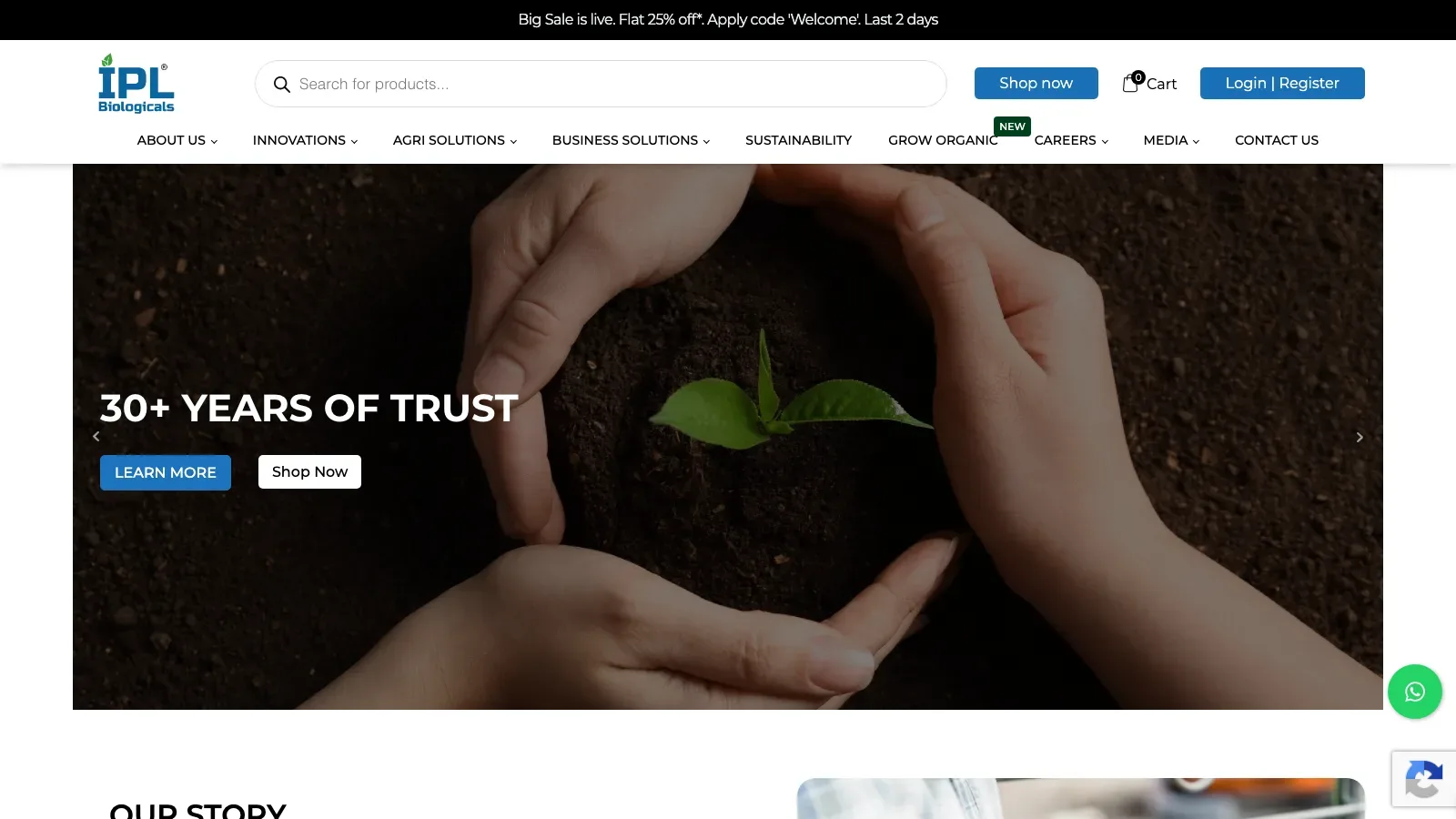
IPL Biologicals WooCommerce store and corporate site on a custom Oxygen Builder theme, built by Mohit Goyal in 2023 and maintained on a retainer since 2025, including the Grow Organic sub-brand. IPL Biologicals (International Panaacea Ltd) makes biofertilisers and biopesticides. It needed one site that worked as a company website and an online shop for its agri products. The product range covers bio-fertilisers, bio-fungicides, bio-insecticides and bio-stimulants, plus B2B lines. The audience splits in two: farmers who browse on mobile and distributors who research on desktop. The site had to serve both from one catalogue, carry the company's corporate content, careers, media and knowledge-centre sections, and sell online. The main build ran from September to December 2023, with maintenance through April 2024. Since 2025 the marketing team has needed a developer on call for a steady stream of changes, which is the retainer. I built the site on WordPress and WooCommerce with a custom theme on Oxygen Builder and Advanced Custom Fields (ACF). It has customised product pages that read well on mobile and desktop, category landing pages, a careers section with job listings, media and knowledge-centre sections, promotional coupons and on-page SEO. On the retainer I added phone-OTP (one-time code) login for customers and admins over SMS, bulk MRP updates from a sheet and a replacement catalogue PDF. I published News posts for the Mitsui and AgSmart Philippines distribution partnership and the Bernard Blum Awards 2025 bronze. Stock rules mark fertiliser SKUs above 1 kg out of stock while keeping size dropdowns uniform, so sizes show as unavailable rather than vanishing. I also fixed the homepage banner autoplay, repaired the video tutorials page and added Hindi tutorials for a multilingual section. I restored order emails after the company moved from Gmail to Outlook, fixed WooCommerce Analytics order reporting, supported the Amazon Seller Central listing and built an international business page with a world map. In 2025 I also launched Grow Organic, IPL's consumer urban-gardening sub-brand, inside the same store. From the marketing team's Figma brief I built the landing page at iplbiologicals.com/grow-organic and the Neem Kavach product page on Oxygen Builder, with the sub-brand's own logo, colours and menu tab, fixed image specs so new products drop in without re-cropping, and an Amazon call to action. Building it inside the existing install kept orders, stock and admin in one place. The stack is WordPress, WooCommerce, Oxygen Builder, Advanced Custom Fields, PHP, SMS OTP and Amazon Seller Central. A custom theme on Oxygen was the right call for a catalogue where product pages differ by type and need structured fields rather than free-form layouts. SMS OTP login removed login friction for customers who mostly log in from a phone. The stock rule was implemented as a rule rather than by deleting variations, so the size dropdown stays uniform across products. No performance or traffic metrics were measured for this work. The marketing team can now update prices in bulk, publish news, manage stock by size, give customers and admins a phone login and track orders in WooCommerce Analytics, with a developer on retainer for the rest. The site is live at iplbiologicals.com. Need a developer on retainer for a WooCommerce store that keeps changing? Tell me what the backlog looks like and I will reply with a plan.

WordPress WooCommerce Advanced Custom Fields Oxygen Builder

Publication

IIID Inscape Website Development

2023

IIID Inscape WordPress publication site for the Institute of Indian Interior Designers' magazine, built by Mohit Goyal with CPT UI and ACF for articles. The engagement ran from August to December 2023 as a freelance project, with an ongoing maintenance plan after launch. IIID Inscape was a static publication with no easy way to publish new articles or showcase member portfolios. Every new feature meant developer time. The member work that is the heart of an interior design publication had no structured home on the site. The goal was a dynamic site that editors could publish to themselves, with articles and portfolios modelled properly so they could be listed, filtered and presented consistently, and a design that worked mobile-first. I started with stakeholder workshops and a content audit to define the structure. I then used CPT UI (a custom post type tool) and Advanced Custom Fields (ACF) to build custom post types for articles and portfolios with flexible fields the editors could manage themselves. The Figma designs became a mobile-first custom WordPress theme built on Oxygen Builder. I added image compression and caching for speed, integrated third-party APIs and secure authentication modules, and set up SSL, backups and restore. I trained the admins so they could publish without me. The stack was WordPress, CPT UI, Advanced Custom Fields, Oxygen Builder, PHP and Figma. Custom post types were the core decision. Treating articles and portfolios as structured content rather than pages gave the editors consistent templates and gave the site listing and archive pages for free. Advanced Custom Fields kept the editing experience to filling in fields. Image compression and caching mattered more than usual because a design publication is built on large photography. Backups and restore were set up from day one because the site held an archive the institute could not recreate. After launch the client reported 40 percent faster page loads, a 25 percent increase in engagement on article and portfolio pages, and editors publishing new features 50 percent quicker. Editors could add an article or a member portfolio through a form-like interface and see it appear in the right place with the right layout. The site is no longer online. Publishing a magazine or member showcase that still depends on a developer for every article? Send me the details and I will reply with a plan.
WordPress CPT UI Advanced Custom Fields Oxygen Builder

Corporate website

Orilite

2023

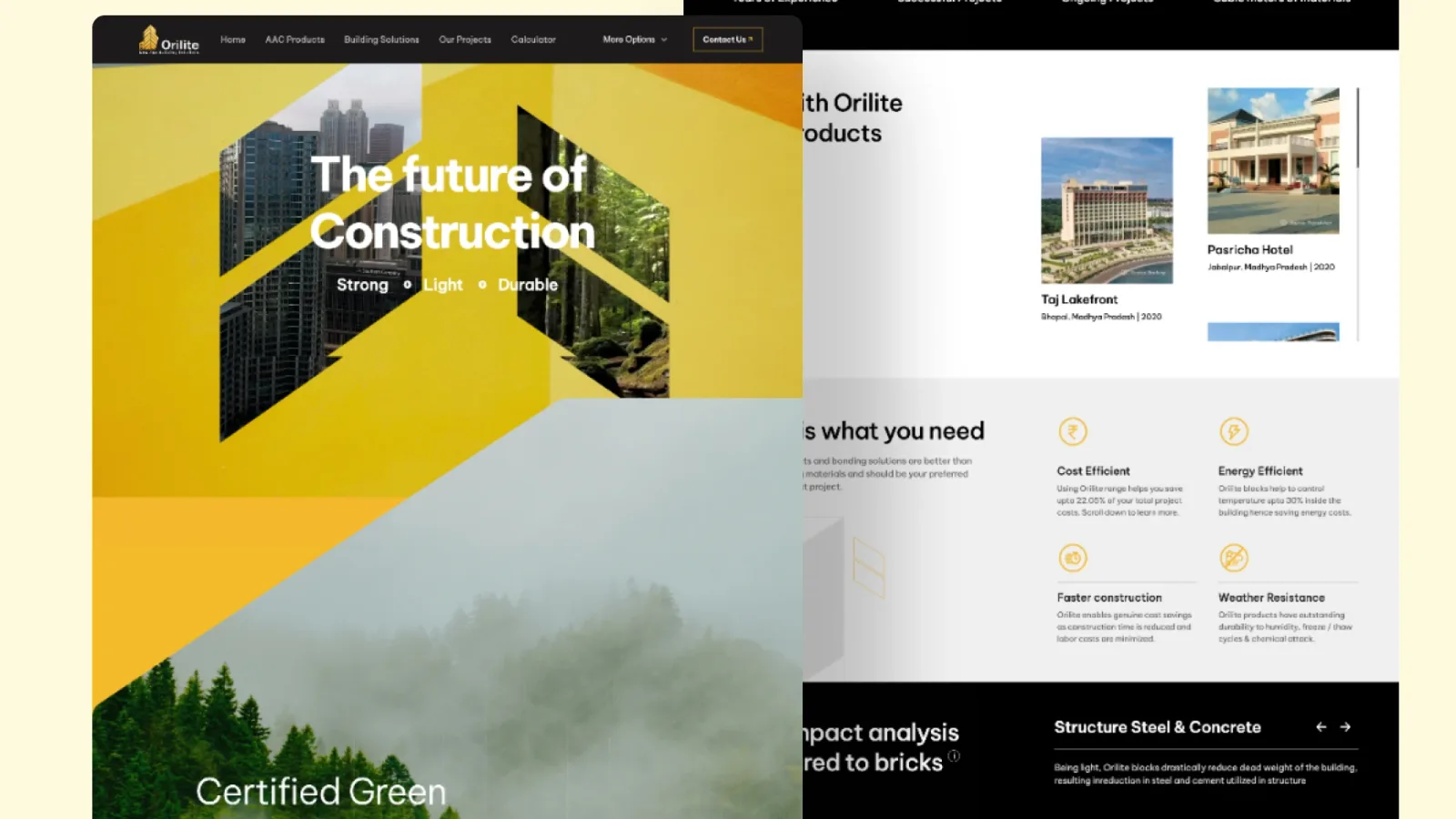
Orilite Figma to WordPress website for a BIS-certified AAC block and mortar brand, built by Mohit Goyal with custom PHP templates on Oxygen Builder and ACF. Orilite is a brand of Oriental Power Cable Ltd in Kota, Rajasthan, and the engagement ran from June to October 2023 as a freelance project. Orilite manufactures AAC blocks and the Orifix mortar range. They had a finished design and needed a corporate site that their team could update without a developer: new products, new project showcases, events and marketing content, all without breaking the layout. The site also had to carry the practical tools a building materials buyer expects, such as a way to estimate materials for a job, and present the brand's certification and product range clearly. I translated the Figma mockups into bespoke PHP templates built on Oxygen Builder, with Advanced Custom Fields (ACF) for product details, project showcases, events and marketing content. The site includes AAC product pages, building-solution pages, a projects gallery, a materials calculator, and careers and events sections. Around the build I handled image optimisation, caching, responsive breakpoints, SSL and cross-browser QA. Training and documentation let the client's team take over content. The stack was WordPress, Advanced Custom Fields, Oxygen Builder, PHP and Figma. Bespoke templates were the right choice because the design was fixed and the content was structured. A product page always has the same kinds of fields, so a template with ACF behind it is both more faithful to the design and easier to update than a page built by hand. Oxygen Builder gave the pixel control the Figma file demanded. Caching and image optimisation were set up because product and project imagery dominates the page weight on a materials site. After launch the client reported 25 percent faster load times, a 15 percent increase in engagement on product pages and 40 percent less time spent on content updates. The team can now add a product, a project or an event by filling in fields, and the materials calculator gives buyers an answer without a phone call. Training and documentation mean the team does not need me for routine updates. The site is live at orilite.in. Manufacturing products that need a catalogue site your team can update alone? Send me your next project and I will reply with a plan.
WordPress Advanced Custom Fields Oxygen Builder PHP

Corporate website

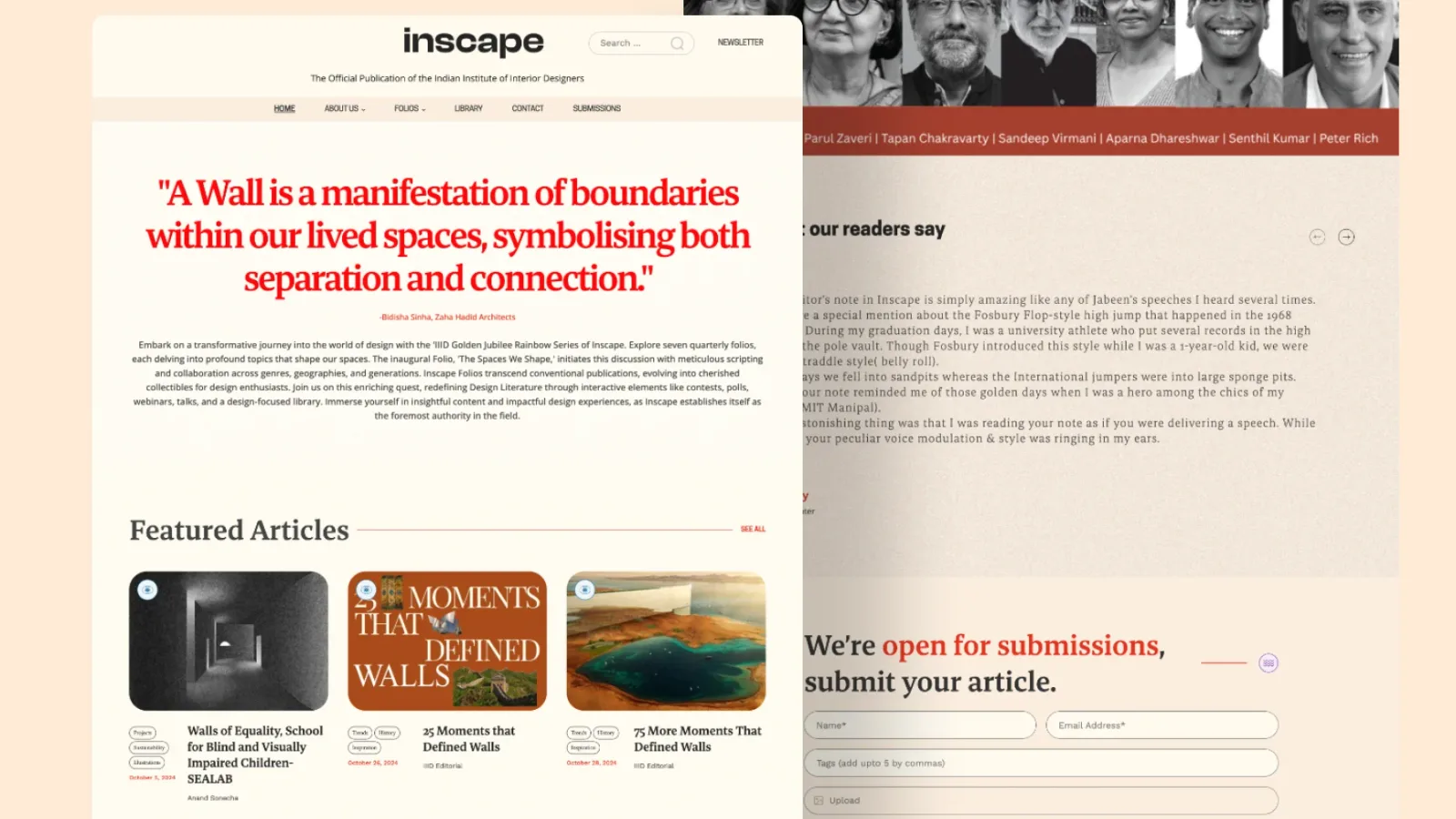
CyberVie WordPress Website

2023

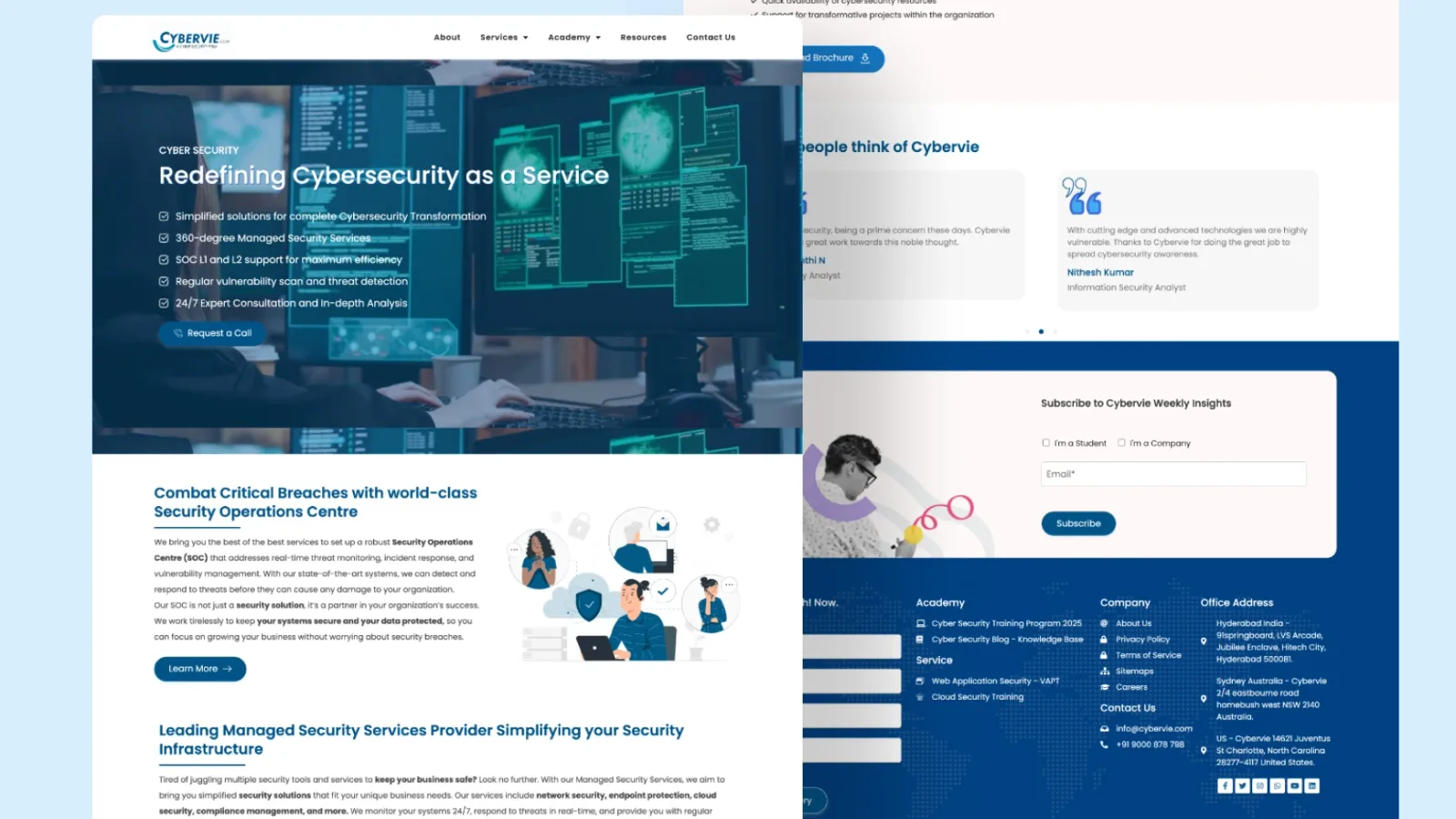
CyberVie WordPress website revamp for a cybersecurity services company, moved to Elementor Pro and ACF by Mohit Goyal, plus the Upskill Ionots learning portal. The main build ran from January to March 2023, with the freelance engagement continuing through 2023. CyberVie offered security services and training from an outdated static site that was hard to update and did not present their courses well. The team had UI designs ready but no way to turn them into pages they could manage. Alongside the main site, Ionots, the training arm connected to CyberVie, needed a dedicated learning portal. Prospective students had to be able to browse courses in data science, AI and cybersecurity, read syllabi and enrol. The goal was two sites the team could run without touching code. Working from the client-provided UI designs, I rebuilt cybervie.com on WordPress with Elementor Pro for flexible layouts and Advanced Custom Fields (ACF) so the team could manage content without code. I redesigned the homepage and built landing pages for their services: VAPT, SOC as a Service, DFIR and training. I applied on-page SEO, tuned performance and set up backups and security. For Upskill.Ionots.com I modelled each course with Advanced Custom Fields, covering duration, modules, instructors, pricing and call-to-action blocks, so the team fills in a template rather than designing a page. I handled the responsive layout, cross-browser testing and performance tuning. The stack was WordPress, Elementor Pro, Advanced Custom Fields, PHP and SEO. Elementor Pro suited the service pages, where layouts vary and marketing needs to adjust them. Advanced Custom Fields suited the courses, where every entry has the same structure and consistency matters more than freedom. Splitting the two that way meant marketing pages stayed flexible and course pages stayed uniform. Backups and security were set up as part of the build, which for a cybersecurity company is table stakes. The client reported better engagement and much simpler content management after launch. The founder of CyberVie wrote that I consistently deliver projects before deadlines and with excellent quality. The team can now update service pages in Elementor Pro and add a course by filling in fields. The main site is live at cybervie.com; the upskill subdomain is no longer online. Running a services company with a course catalogue to present? Send me your next project and I will reply with a plan.
WordPress Elementor Pro Advanced Custom Fields PHP

Real estate

PropAlert Real Estate Website

2024

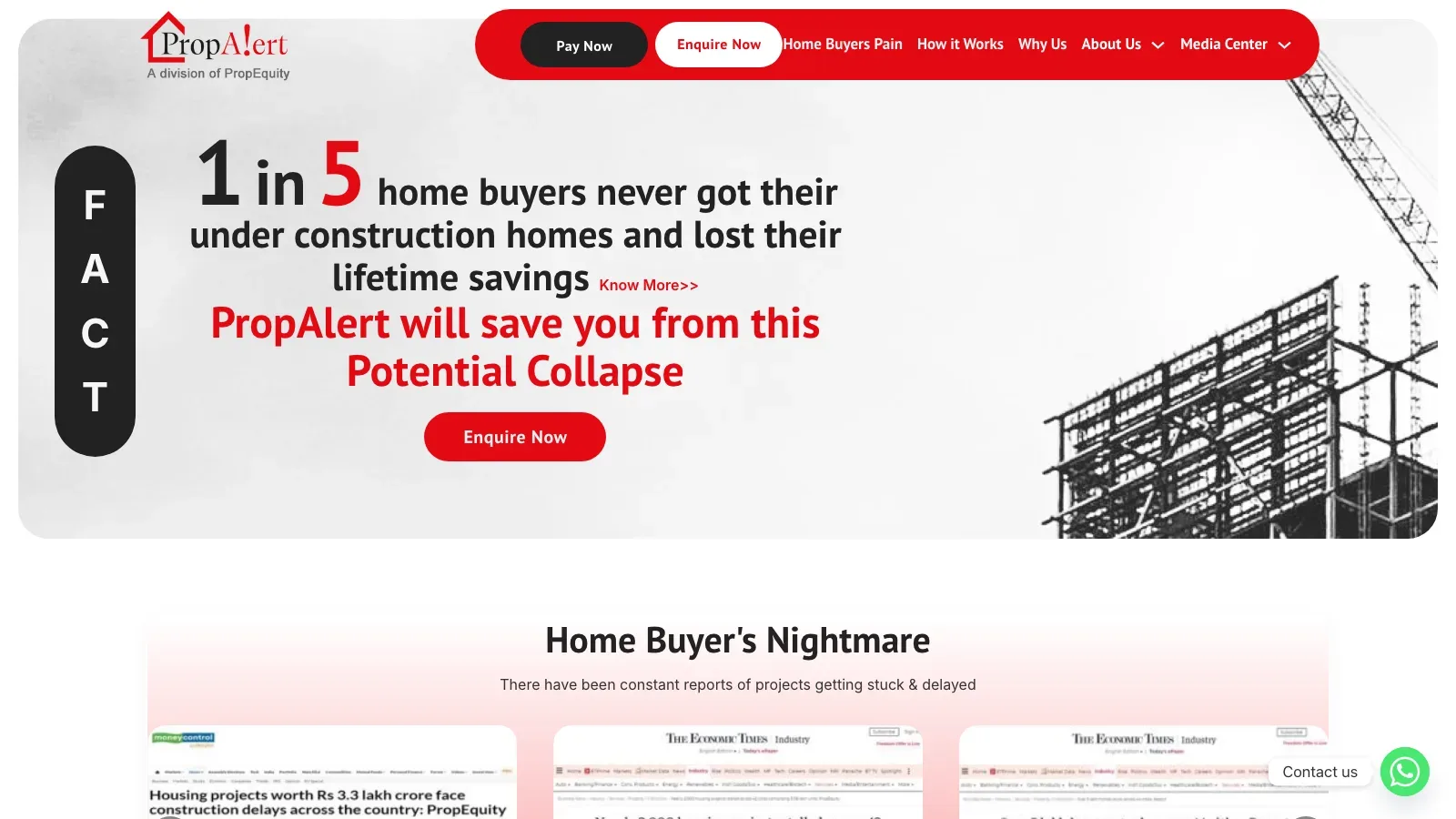
PropAlert WordPress website for an Indian real estate data platform, built by Mohit Goyal with custom plugins and OTP phone verification wired into WPForms. The engagement ran from July to August 2024 as a freelance project, and the site is live at propalert.in. PropAlert helps home buyers track under-construction projects and avoid stalled developments. The site claims coverage of 57,000 developers in 44 cities and partnerships with 200 banks and institutions. The problem it solves is unfamiliar to most buyers, so the site had to explain it clearly before asking for anything. It also had to capture leads that the sales team could act on and take payments. Lead quality mattered. An enquiry with a wrong or fake phone number is worth nothing to a business that follows up by phone. I built the site on WordPress with a custom theme. The pages use long-form sections for buyer pain points, how the service works, media coverage and videos. A first-time visitor understands the problem and the product before reaching a form. I built Pay Now and Enquire Now flows for the two actions the business wanted. Because lead quality mattered, I wrote custom plugins and connected WPForms to an OTP (one-time code) API, so every enquiry comes with a verified phone number before it reaches the team. The stack was WordPress, PHP, WPForms, a REST API and JavaScript. A custom theme rather than a builder gave me control over the long-form layout and kept the page weight down. WPForms was kept as the form layer because the team already knew it. The verification was added around it with custom plugins and the OTP API rather than replacing it, so the team's workflow did not change. JavaScript handles the OTP step in the form itself, so the visitor verifies their number without leaving the page. The custom plugins keep the verification logic separate from the theme, so a theme change later does not touch the lead flow. No traffic or conversion metrics were measured for this work. The team can now trust that every enquiry has a verified phone number, take payments through the site, and edit the explanatory content as the product grows. The site is live at propalert.in. Getting fake phone numbers through your lead forms? Send me your next project and I will reply with a plan for verified enquiries.

WordPress PHP WPForms REST API

Healthcare

Janssen Neuroscience WordPress Site

2022

Janssen Neuroscience (Johnson & Johnson) WordPress site built by Mohit Goyal as a static-first deployment on Platform.sh, with plugins managed by Composer. This was an enterprise WordPress build with stricter rules than a typical agency project, delivered as a freelance engagement from October to December 2022. Janssen's team needed a neuroscience microsite that fitted their existing hosting and compliance setup rather than the other way round. That meant WordPress running on Platform.sh, a managed cloud host, with every theme and plugin pinned to a version and installed through Composer, the PHP dependency manager, so the build was reproducible. Content was served statically so the public site had a small attack surface. The designs were supplied. The challenge was delivering them inside those constraints and across the Platform.sh environments the team used for review and release. I set up the Composer-based project structure so WordPress core, the theme and every plugin were declared as dependencies with pinned versions. I built the theme and page templates to the supplied designs and deployed to the Platform.sh environments. I handled QA across devices so the microsite rendered correctly on desktop and mobile before each review. Each change went through the same path: a commit, a build on the environment, a review on its URL, then a merge. The stack was WordPress, PHP, Composer and Platform.sh. Composer management was a requirement, not a preference, and it is the right one for enterprise WordPress. A lockfile makes every environment identical and makes updates a reviewed change rather than a click in the admin. Platform.sh gave branch-based environments, so a change could be reviewed on its own URL before merging. Serving the site statically removed the live database and admin from the public surface. That is the biggest single security gain available to a content site. No performance or traffic metrics were measured for this work. The team received a microsite that deployed the same way every time, could be updated through version control and exposed as little as possible to the public internet. The Platform.sh preview environment I worked on is no longer online and the production URL is not public, so there is no live link. Need WordPress delivered under enterprise rules, with pinned dependencies and reviewed deploys? Send me the requirements and I will reply with a plan.
WordPress PHP Composer Platform.sh

WordPress plugin

Geo Targeting for Bricks Builder

2025 – Present

Geo Targeting for Bricks Builder is a WordPress.org plugin by Mohit Goyal that shows or hides Bricks elements by visitor country, resolved via IPinfo Lite. I published it in November 2025 and maintain it alongside my HTTP Security Header plugin. It is currently at version 1.5.1 and tested up to WordPress 6.9. Bricks Builder has a conditions system but no way to vary content by location. Agencies serving several countries were duplicating pages: one for each region, with the same layout and different prices, phone numbers or offers. That is slow to build and worse to maintain. The goal was a country condition that any Bricks element could carry, with the lookup done in a way that did not flash the wrong content first or store anything about the visitor. The plugin adds a country condition to any Bricks element. Site owners add their IPinfo token in the plugin settings, then pick countries to include or exclude on an element: pricing in the right currency, local phone numbers, region-specific offers. The lookup runs on the server through IPinfo Lite, so there is no client-side flicker and no personal data stored. I wrote the companion guide on getting an IPinfo API token, so a site owner can go from install to a working condition without leaving the documentation. The stack is PHP and WordPress, built against the Bricks Builder conditions API and the IPinfo REST API, and distributed through WordPress.org. Resolving the country on the server was the central decision. A client-side lookup would render the default content first and swap it after the request returned, which is visible to the visitor and bad for layout stability. Doing it in PHP before the page renders avoids that. Nothing is written to the database, so the plugin has no personal data to protect. It requires WordPress 6.0 or later and PHP 7.4 or later. The plugin is young and has a small install base; no usage metrics beyond that are measured. Bricks site owners can now keep one page per layout and let the country condition decide what each visitor sees, with no duplicate pages to keep in sync. It is live on WordPress.org at wordpress.org/plugins/geo-targeting-for-bricks-builder. Need a Bricks Builder or WordPress plugin built for a gap in your workflow? Send me the idea and I will reply with a plan.
PHP WordPress Bricks Builder REST API

Web app

Humora AI Rewriting Tool

2026

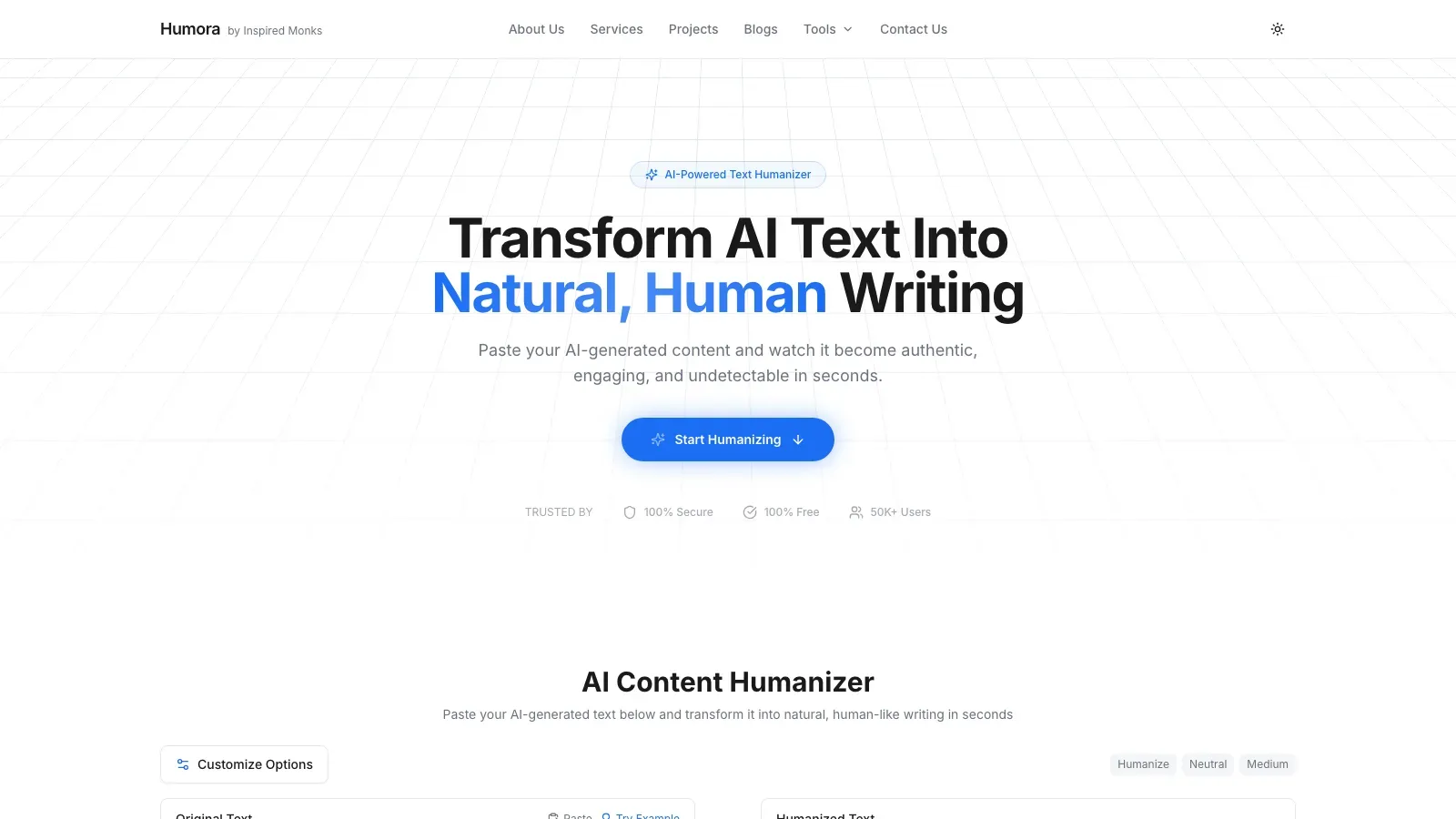
Humora is a free AI rewriting tool by Mohit Goyal in JavaScript on an LLM API: it rewrites drafts in five writing modes with tone controls, 12 languages and a diff view. I launched it in February 2026 under my Inspired Monks brand, with a companion article on inspiredmonks.com, and it is live at humora.inspiredmonks.com. A first draft often reads stiff, and the writing tools that help charge a monthly fee for what is, at its core, a well-prompted rewrite. I wanted a free alternative good enough to use every day. It had to let the writer control the voice of the result rather than accept one house style, and show its work so the writer could see what changed and why. You paste up to 500 words and choose a writing mode, from Academic and Business to Creative and Social Media. You pick one of five tones and one of three rewriting strengths, and the result streams back word by word. Extras include translation into 12 languages, a readability simplifier that brings text to an eighth-grade level, grammar fixes, and a before-and-after diff that explains each change. Drafts auto-save, so a page refresh does not lose work. Each control changes the request rather than adding a step, so the whole tool stays on one screen. The frontend is a streaming JavaScript interface in HTML and CSS, backed by an LLM (large language model) API. Streaming was the main technical choice. Showing the rewrite as it arrives makes a several-second generation feel immediate and lets the writer start reading before it finishes. The mode, tone and strength controls are composed into the request rather than offered as separate tools, which keeps the interface to one screen. The diff view is computed on the client against the original text, so the explanation of changes does not need another round trip. The 500-word limit keeps each request small enough to stream quickly and keeps the service free to run. No usage metrics are measured for this project. Anyone can now take a stiff draft and get a clearer version in their chosen register and language, with every change visible, for free and without an account. Humora is live at humora.inspiredmonks.com. Want an AI writing tool of your own with streaming output and a clean interface? Send me the idea and I will reply with a plan.

JavaScript LLM API HTML CSS

Web app

Free Tools on Inspired Monks

2024 – 2025

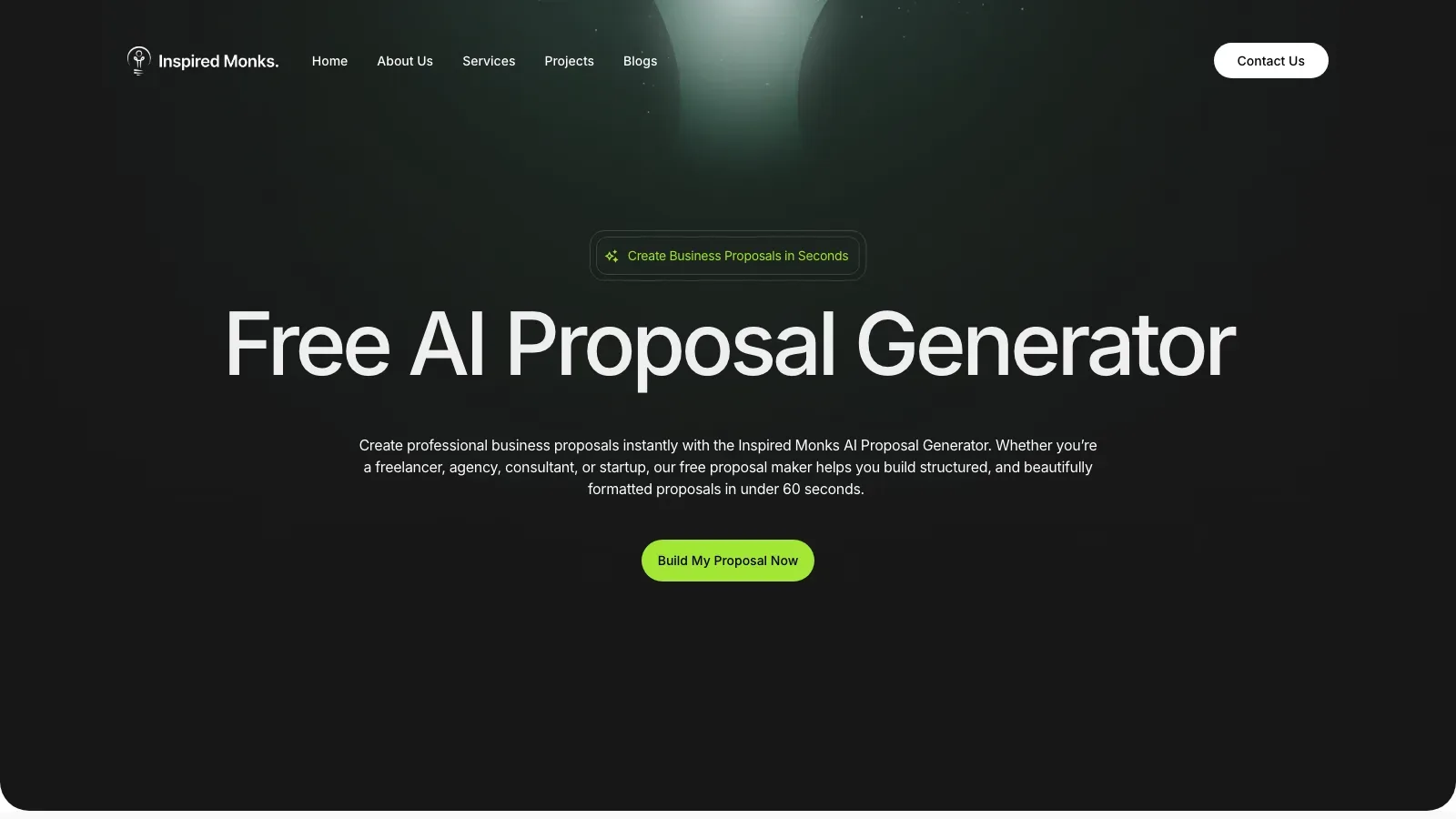
Free Tools on Inspired Monks: three free browser tools built by Mohit Goyal on inspiredmonks.com, an AI proposal generator, a GST-ready invoice generator and an HTTP security header scanner. I built these between 2024 and 2025 for freelancers, small businesses and site owners. Each one does a single job, needs no account and keeps the user's data on their own device wherever it can. The AI Proposal Generator turns a few client details into a complete proposal. An LLM (large language model) drafts the executive summary, scope of work, timeline and about sections. Five templates and a tone switch set the style, a live editor allows changes before export, and pricing tables handle taxes, discounts and INR, USD and EUR. Drafts auto-save on the device and export to PDF or DOCX. It is live at inspiredmonks.com/proposal-generator. The Free Invoice Generator produces tax-correct invoices for Indian and global businesses. It switches tax fields by currency: IGST, CGST, SGST and CESS for INR, sales tax for USD and VAT for EUR and GBP, across more than 150 currencies, with logo upload, drag-and-drop line items and a clean PDF download. Everything runs and saves in the browser, so there is no account, no email capture and nothing stored on a server. It is live at inspiredmonks.com/invoice-generator. The HTTP Security Header Scanner grades any website from A+ to F. A PHP REST endpoint on WordPress fetches the response headers server-side, because a browser cannot read another site's headers, and a JavaScript frontend scores HSTS, Content-Security-Policy, X-Frame-Options, X-Content-Type-Options, Referrer-Policy and Permissions-Policy. Each finding explains what the header protects against, gives a step-by-step fix and links to my 15-article series on security headers and my WordPress plugin. It is live at inspiredmonks.com/http-security-header-scanner. No usage metrics are measured for these tools. Together they show the kind of small, focused web app I build: one screen, no sign-up, and a finished result in about a minute. Need a calculator, generator or diagnostic tool that runs in the browser? Send me the idea and I will reply with a plan.

JavaScript PHP WordPress LLM API

Case studies

The thinking behind the work

All case studies

Let's build

Have a site that needs to be fast, rank and convert?

Open to Work. Usually replies within a day.