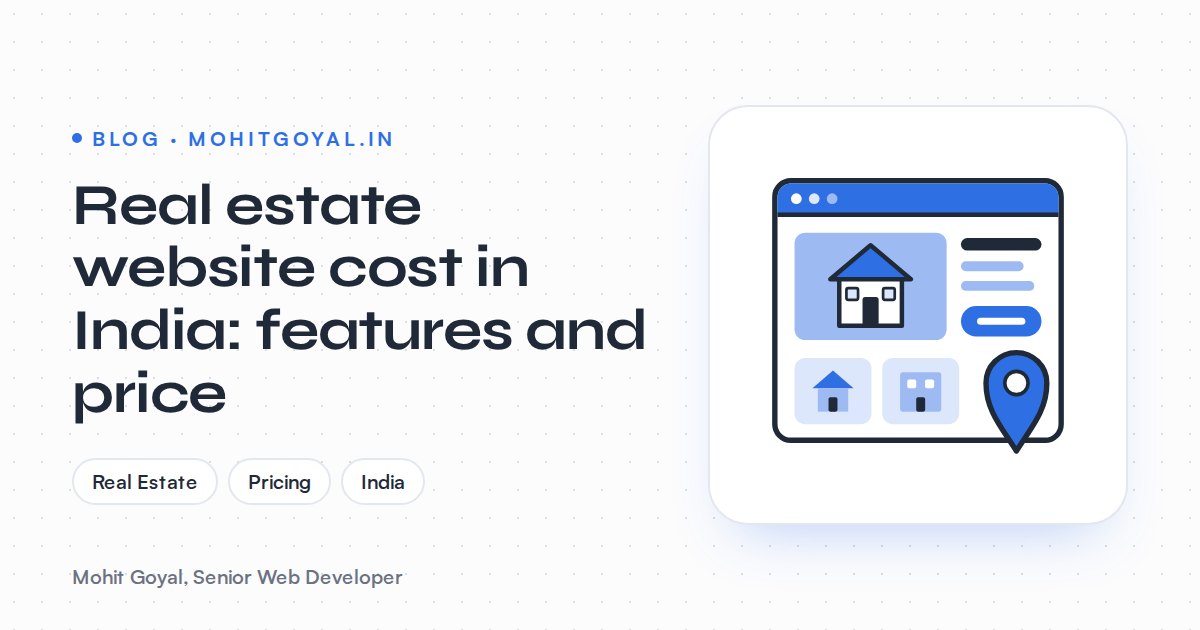
A real estate website in India costs roughly ₹15,000–₹35,000 for a template WordPress site and ₹60,000–₹1.5 lakh for a custom-designed WordPress build with property listings (Acreate). A custom listing portal runs ₹2.5–6 lakh, and a full portal with CRM sync, virtual tours and listing feeds, or a multi-city aggregator, runs ₹5–20 lakh (Selyst). Features set the price, not page count: how listings get uploaded, how deep the filters go, whether leads are verified and whether enquiries flow into a CRM.
Most price guides stop at listings and filters. They skip the thing that costs property businesses the most once the site is live, which is junk leads. Fake and mistyped numbers in the enquiry form, plus the odd bot, eat into your sales team's day. I'll cover that too, using a build I did for an Indian real estate platform.
How much does a real estate website cost in India?
Most real estate websites in India cost somewhere between ₹15,000 and ₹20 lakh. Where yours lands depends on scope: a broker's five-page WordPress site sits at the bottom, a 99acres-style portal at the top. That's why the published ranges are all over the place. HTBG quotes anything from ₹15,000 to over ₹5 lakh, while Shivah Webtech puts a typical real estate site at ₹85,000–₹2,00,000. Here's how the tiers usually split:
| Build type | Typical price | Typical timeline | Best for |
|---|---|---|---|
| Template WordPress site | ₹15,000–₹35,000 | 7–12 days | Solo agents, small portfolios |
| Custom-designed WordPress with listings | ₹60,000–₹1.5 lakh | 3–5 weeks | Growing brokerages, small builders |
| Custom listing portal (50–200 properties) | ₹2.5–6 lakh | 8–12 weeks | Agencies with several agents |
| Multi-city aggregator or developer portal | ₹8–20 lakh | 14–20 weeks | Aggregators, large developers |
The first two rows and their timelines come from Acreate. The portal rows come from Selyst, which says its figures exclude 18% GST. Check whether a quote includes GST before you put two proposals side by side.
If you're still choosing a platform, my guide to WordPress website costs in India covers the general picture. This post sticks to the features that are specific to property sites.
What does each real estate feature add to the cost?
According to Selyst, the priciest real estate features in India live in the back office, not the design: a bulk CSV upload panel (₹1.2–3 lakh), two-way CRM sync (₹80,000–₹2 lakh) and advanced filters (₹60,000–₹1.2 lakh). Each row below is a feature you'll get asked about, with a market range and a named source.
| Feature | Market build cost | Running cost | Source |
|---|---|---|---|
| Property listings, manual entry (under 30) | Included in a ₹60,000–₹1.5 lakh WordPress build | Your team's time | Acreate |
| Bulk CSV upload and admin panel | ₹1.2–3 lakh | None | Selyst |
| Basic filters (location, price, BHK) | ₹15,000–₹30,000 | None | Selyst |
| Advanced filters (carpet area, possession, RERA, floor) | ₹60,000–₹1.2 lakh | None | Selyst |
| Map search with radius or polygon | ₹40,000–₹80,000 | Maps API usage | Selyst |
| Contact form to email | ₹5,000–₹10,000 | None | Selyst |
| Lead management system | ₹35,000–₹75,000 | None | HTBG |
| OTP-verified lead forms | Custom plugin work, scoped per site | ₹0.13–₹0.25 per SMS + GST | SignOps |
| Lead routing to the right agent | ₹30,000–₹60,000 | None | Selyst |
| One-way CRM sync (website to CRM) | ₹40,000–₹80,000 | CRM seats | Selyst |
| Two-way CRM sync | ₹80,000–₹2 lakh | CRM seats | Selyst |
I couldn't find a reliable published range for OTP verification on its own, so I haven't invented one. It depends on your form plugin, your SMS gateway, and whether you need resend limits and fallbacks.
- Form to email10₹k
- Basic filters30₹k
- Lead routing60₹k
- One-way CRM sync80₹k
- Map search80₹k
- Advanced filters120₹k
- Two-way CRM sync200₹k
- Bulk upload panel300₹k
The chart uses the top of each Selyst range. Look at the biggest bars: none of them have anything to do with how the site looks.
Why do junk leads matter more than another filter?
Every fake, mistyped or bot-submitted number on your enquiry form costs your sales team a call that goes nowhere, and it leaves a useless record sitting in the CRM. A standard form accepts any ten digits. Bots fill it in. People get a digit wrong. And some visitors type a fake number on purpose so they can grab the brochure without getting a call.
Property portals make this worse. Acreate points out that portal leads are often low-intent and shared, so the buyer may be ringing several agents at once (Acreate). Your own website is the one place where you decide what counts as a lead.
You can stack a few cheap layers of protection:
- Server-side validation of Indian mobile numbers (10 digits, valid starting digit) catches typos.
- A honeypot field or reCAPTCHA keeps out most bots.
- Qualifying fields like budget, BHK and preferred location let your team sort leads before picking up the phone.
- OTP phone verification is the only layer that proves the person actually owns the number.
You don't need OTP on every form. I'd put it on the high-intent actions: site-visit bookings, brochure downloads and price-on-request enquiries.
How does OTP-verified lead capture work?
The form sends the visitor a code by SMS, and the lead is only saved, emailed or pushed to your CRM once the code matches. In India each message costs about ₹0.13–₹0.25 plus GST, and you need DLT registration before you can send any.
The running cost is small. Indian SMS providers charge about ₹0.13–₹0.25 per OTP plus 18% GST (SignOps), and resends are billed too. SignOps works out that 1,000 verifications a month at ₹0.17 comes to about ₹204 once you allow for 20% resends. One wasted sales call costs more than that.
The catch is DLT. Under TRAI's commercial SMS rules, you have to register your business, a sender ID and every message template on an operator's DLT platform. Anything that doesn't match a registered template gets blocked, and approval takes days, not minutes (SignOps). Start it in week one so it doesn't hold up launch. WhatsApp authentication messages are an alternative, though you'll need WhatsApp Business approval for those.
If you want the technical side, I've written a walkthrough on adding OTP phone verification to WordPress forms.
What did I build for PropAlert?
For PropAlert, an Indian real estate data platform, I built a WordPress website in 2024 with custom plugins and OTP phone verification wired into WPForms. The idea was simple: an enquiry only counts once the person has proved the number is theirs.
Wiring verification into an existing form builder, rather than replacing it, is the approach I'd recommend in general. The form builder stays the editing tool and the verification logic sits underneath in a custom plugin, so adding a field or changing a label shouldn't need a developer. That's the sort of work I do under custom WordPress plugins and internal tools: one small plugin that fits how you work, rather than a stack of generic ones getting in each other's way.
What are the running costs after launch?
A small real estate website in India needs a yearly budget for hosting (₹3,000–₹8,000), a domain (₹500–₹1,500) and maintenance (₹8,000–₹12,000), plus CRM seats and SMS if you use them. The build fee isn't the whole bill:
| Item | Typical cost | Source |
|---|---|---|
| Hosting | ₹3,000–₹8,000 a year | Acreate |
| Domain | ₹500–₹1,500 a year | Acreate |
| Maintenance, small agent site | ₹8,000–₹12,000 a year | Selyst |
| Real estate CRM | About ₹500–₹2,000 per user a month | Makanify |
| SMS OTP | ₹0.13–₹0.25 per message + GST | SignOps |
A bigger portal costs more to keep running. Selyst suggests ₹25,000–₹80,000 a year for a mid-size portal once you add a CDN and heavier maintenance.
Should a real estate site use WordPress or custom code?
For most Indian agents, brokerages and builders, I'd pick WordPress. Custom code such as a Next.js frontend only earns its cost on portals with buyer accounts, thousands of listings or external data feeds. In WordPress, properties map neatly onto a custom post type, and fields like BHK, carpet area, possession status, price and RERA number sit naturally in Advanced Custom Fields. Your staff add a listing by filling in a form, not by fiddling with a page layout. I've used that pattern on content-heavy builds and it holds up well.
Off-the-shelf real estate themes like Houzez cost around ₹3,000–₹12,000 (HTBG). They're quick to set up, but they ship a lot of features you won't use, and you feel that weight on mobile. When speed matters, I build the listing system from custom post types on Bricks, Elementor or Oxygen, so each page only loads what it needs.
Whatever you build on, property photos will be the heaviest thing on the site. Compress them before upload. My free Under1MB image converter does it in the browser, and nothing gets uploaded to a server.
What should you ask a developer before you sign?
Two quotes for "a real estate website" can be lakhs apart because they assume different things. Ask about GST, listing uploads, CRM sync direction, junk-lead protection, DLT ownership, OTP fallbacks, staging and account ownership, and you'll be comparing like with like:
- Is the price inclusive of 18% GST?
- How do listings get uploaded? One at a time in the admin, or by CSV import?
- Is CRM sync one-way or two-way, and have you integrated my CRM before?
- How will you stop junk leads? Ask which forms get OTP and what happens to bot submissions.
- Whose name goes on the DLT registration and sender ID? It should be your business, not the developer's.
- What happens if the OTP doesn't arrive? Ask about resend limits, expiry and a fallback.
- Can I test a staging site before the final payment? Selyst recommends tying payments to milestones.
- Who owns the hosting, domain and plugin licences? They should all be in your business's name. A vague answer here is a red flag.
Write your scope down before you ask for quotes. My free Project Scope Generator turns a two-line idea into a ranked feature list and page map you can send to any developer.
Next step
If you're planning a property website and want leads your team can actually call, send me your listing count, the filters you need, your CRM (if you have one) and which forms should be verified. I'll tell you which parts need custom work and which don't. Book a 20-minute call and we'll go through it.