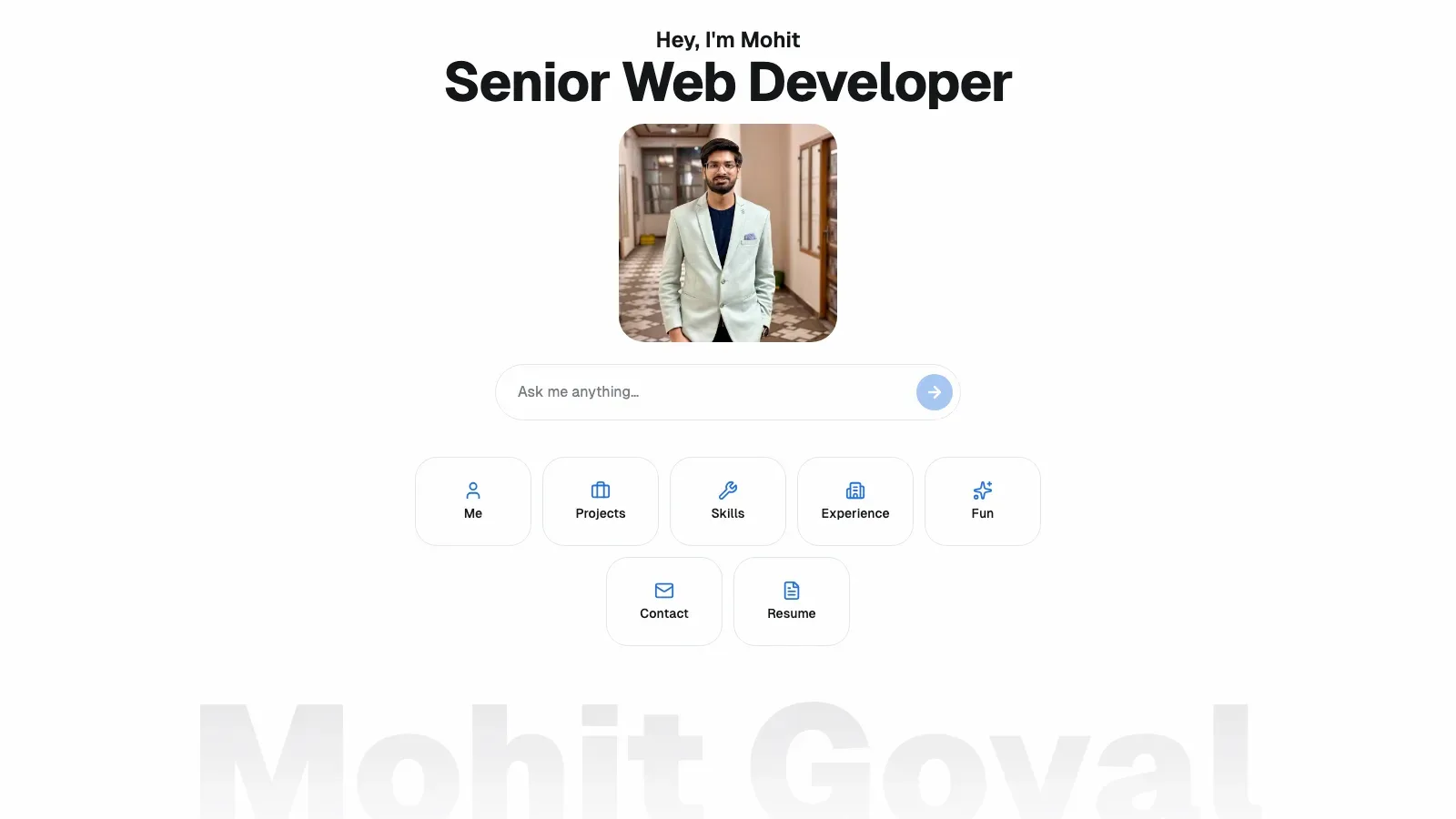
Freelance web developer in Gurugram and Delhi NCR

I'm Mohit Goyal, a freelance website developer based in Gurugram. I build fast Next.js, WordPress and WooCommerce websites for businesses in Gurugram, Delhi, Noida, Faridabad and the rest of Delhi NCR, and you work with me directly from the first call to launch.

Why hire me

A website developer in Delhi NCR you deal with directly

  • One person, start to finish

    You talk to the developer who writes the code. I scope it, build it and hand it over, so nothing is lost between a salesperson and a team you never meet.

  • Your working hours

    I'm in Gurugram, on India time. Calls, reviews and fixes happen in your working day, not overnight.

  • Built to rank and load fast

    Every build is checked on real phones and against Core Web Vitals before launch, with redirects, sitemap and schema in place.

  • Handed over documented

    The site is deployed, documented and walked through, so your team can run it without me.

Services

What I build

Next.js and React websites

I build marketing sites and web apps on Next.js, React, TypeScript and Tailwind CSS, server rendered and deployed on Vercel or Cloudflare. You get a site that loads fast on mobile, ranks on Google and your team can extend.

  • – Next.js or TanStack Start site in TypeScript and Tailwind CSS
  • – Server rendered pages with metadata, Open Graph tags, sitemap and JSON-LD
  • – A component library your team can reuse for new pages
Learn more

WordPress websites on Bricks, Elementor and Oxygen

I build WordPress websites from your Figma design on Bricks Builder, Elementor Pro, Oxygen or a custom theme. Pages are pixel accurate, mobile first and quick to edit. You get a site your team updates without a developer.

  • – Responsive WordPress site on Bricks, Elementor Pro, Oxygen or a custom theme
  • – Pixel accurate build from your Figma file or brand guide
  • – Custom post types and Advanced Custom Fields for structured content
Learn more

WooCommerce stores and online ordering

I build WooCommerce stores for product catalogues and food ordering, with delivery radius rules, Stripe payments, currency switching and automatic kitchen receipt printing. You get a store that takes orders while your staff serve customers.

  • – WooCommerce store on Bricks, Elementor Pro or a custom Oxygen theme
  • – Product catalogue with variations, add-ons and attribute filters
  • – Multi-step checkout with Stripe, WooPayments, Apple Pay or Google Pay
Learn more

Multivendor marketplaces

I build multivendor marketplaces on WooCommerce with WCFM Marketplace. Vendors get their own dashboards, commissions and membership plans, and orders sync to Xero. You get a marketplace where other sellers list and fulfil their own products.

  • – WooCommerce marketplace with WCFM vendor dashboards
  • – Commission rules and vendor membership plans
  • – Xero or other accounting sync for orders and inventory
Learn more

Booking and event landing pages with Stripe

I build booking and event pages with Stripe payments, HubSpot forms and GA4 tracking for venues, hotels, restaurants and conferences. You get a page that turns visitors into enquiries and paid bookings.

  • – Event or venue landing page with clear calls to action
  • – Stripe checkout for tickets, deposits or paid bookings with a date picker
  • – Customer and admin booking emails plus a daily booking summary
Learn more

Headless WordPress

I build headless sites with a Next.js or React frontend on a WordPress backend, with content delivered through the REST API or WPGraphQL. You get modern speed with the editing screen your content team already knows.

  • – WordPress backend with custom post types, ACF and REST or WPGraphQL endpoints
  • – Custom PHP plugins for any logic the API needs
  • – Next.js or React frontend in TypeScript and Tailwind CSS
Learn more

See all 13 services

Proof

Recent work

B2B SaaS

Procol Development

2024 – Present

procol.ai website on Next.js, TypeScript and Tailwind CSS, built and maintained by Mohit Goyal as Senior Web Developer, including the Procol Nexus 2026 summit page. Procol sells a procurement platform to enterprise buyers, and procol.ai is where prospects first meet the product. As Senior Web Developer I build and maintain the site: the product, solution, pricing, blog and campaign pages, and event pages such as Procol Nexus 2026. I built the site on Next.js with React, TypeScript and Tailwind CSS. Every page is server rendered, so the HTML arrives complete and pages load fast on phones. Pages are assembled from a shared library of typed components, so a new landing page reuses tested sections rather than starting from a blank canvas. The SEO foundations are built in: structured data, generated sitemaps, canonical URLs and optimised images, all generated from the same content the pages render so they cannot drift out of sync. Procol Nexus 2026 is Procol's invite-only summit for procurement, finance and IT leaders, and its page lives at procol.ai/nexus. It opens on a full-screen video hero that visitors scroll into, with Framer Motion carrying them from the opening frame into the event details and a registration form for invited guests. The video is treated as progressive enhancement, so the page stays usable while it loads. It runs on the same codebase as the rest of the site, so it is server rendered, indexable and on-brand without a separate microsite. The site is live at procol.ai, and I continue to ship new pages as the product grows. The lesson I keep coming back to: a campaign or event page does not need its own stack to feel special. Strong design, careful motion and fast server-rendered pages do the work. Thinking about moving a marketing site to Next.js, or launching an event page? Send me your next project and I will reply with a plan.

Next.js React TypeScript Tailwind CSS

Personal project

mohitgoyal.in AI Portfolio

2025 – Present

mohitgoyal.in is my AI portfolio site on TanStack Start and React, by Mohit Goyal with a chat that answers as me on the Anthropic Claude API and Firestore. It replaces the brochure portfolio with something a visitor can question, and it doubles as the place where I test the techniques I use for clients. The problem with most portfolios, including my earlier ones, is that they are static brochures. A visitor has to read every section to find out whether I have worked with their stack, and the content goes stale the moment a project changes. I wanted a portfolio that behaves less like a brochure and more like a conversation. A visitor can ask about my work and get an answer in first person, and updating a project updates everything downstream without me editing three places. The 2026 revamp is the version you are reading now. The site is a server-rendered React app on TanStack Start, hosted on Cloudflare. Visitors can read the usual sections or ask the chat about my work. The chat answers as me with structured replies, backed by the Anthropic Claude API and a system prompt built from my Firestore profile, so updating a project updates what the chat knows. Every project has a standalone SEO page at /projects/<slug>, 35+ of them live. Case studies at /case-studies/<slug> and posts at /blog/<slug> are rendered from markdown files in the repo. Service pages at /services/<slug> carry deliverables, a process and an FAQ. A site header and footer sit on a lined grid layout with Syne headings and Satoshi body type. Behind the public site is an admin dashboard where I edit every section. It has version history so I can roll back a bad edit, draft flags for projects, link health checks that flag dead client URLs, an SEO preview for each page and chat analytics that show what visitors actually ask. Search and answer engines get the same care as human readers. Each page carries its own JSON-LD structured data: Person, CreativeWork, BreadcrumbList and ItemList. Every project has an Open Graph image, and the site generates a sitemap and an llms.txt file so answer engines can read the profile directly. Every legacy WordPress URL from Search Console has a 301 redirect, so old links and rankings land on the right new page. TanStack Start was chosen for server-side rendering (SSR) with type-safe routing, which keeps the project pages indexable and the data loading explicit. Firebase Firestore is the content store, and Firebase handles the auth behind the admin, so there is no custom backend to host. Images are served from a dedicated assets subdomain. Cloudflare serves the whole thing at the edge, so the first byte is quick wherever the visitor is. Tailwind CSS and TypeScript round out the stack. The project list on this site is the same data that this very description is drawn from. The site is live at mohitgoyal.in. The main outcome is that I maintain one source of truth. A change in the admin dashboard updates the page, the metadata, the sitemap, the llms.txt and the chat at once. What I learned is that the editorial tooling matters as much as the public pages. Version history, link checks and analytics are what make it cheap to keep the content honest over time. Want a site that can answer questions about your business in your own voice? Send me a note about it and I will reply with a plan.

TanStack Start React TypeScript Tailwind CSS

Web app

Under1MB Image Converter

2026

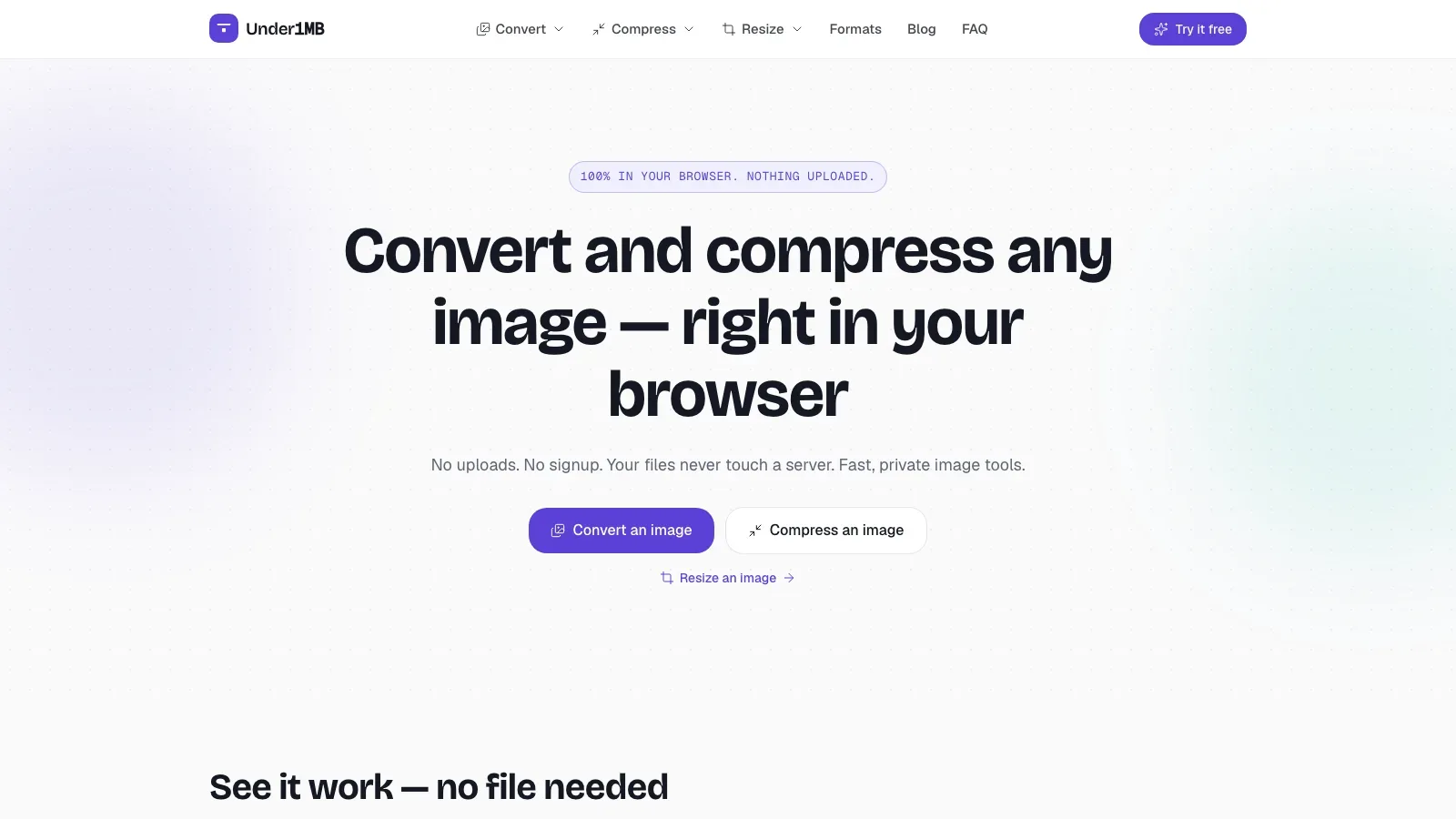
Under1MB is a free browser-based image converter and compressor built by Mohit Goyal in plain JavaScript: 11 formats, no uploads, no signup and no server. I built the product, the site and the branding myself, and launched it in public on LinkedIn. Most online image tools upload your files to a server, put a signup wall in front of the download and cap how many images you can process a day. For anyone who just needs a product photo under a size limit or a batch of screenshots converted, that is a lot of friction. It is also a privacy question they should not have to think about. I wanted a tool where the whole job happens on the user's own device, so there is nothing to upload, nothing to sign up for and no limit to enforce. Under1MB does exactly that. You drop a file, the browser decodes and re-encodes it, and the result is downloaded from memory. Nothing leaves the machine. It supports PNG, JPG, JFIF, WEBP, AVIF, GIF, BMP, ICO, HEIC, HEIF and SVG, so it covers the formats that come off phones and cameras as well as the ones the web wants. A target-size mode hits a chosen file size, such as under 1 MB. That is the use case the name comes from: upload forms and marketplaces that reject anything larger. Batch processing takes a folder of images and returns a ZIP, and a resize option handles the dimension side of the same problem. Every step runs locally, so large batches finish as fast as the device allows rather than waiting on a queue. The stack is deliberately plain: JavaScript, HTML and CSS, with no framework and no backend. Doing the encoding in the browser was the whole point. Keeping the app dependency-free keeps it fast to load and simple to maintain. The target-size mode works by iterating on quality until the output lands under the requested size. That is only practical because the encode loop runs on the user's hardware with no round trip. The absence of a server is also what makes the no-limit promise honest, since there is no cost per image for me to recover. I launched it in public on LinkedIn, where the launch post drew 45 reactions as reported on the post. The product is live at under1mb.app, and a Pro tier is planned. What I learned building it is that a strong constraint, in this case no server at all, makes product decisions easier. Every feature either works client-side or it does not ship, and that discipline produced a tool that is simpler than the alternatives it replaces. Have an idea for a small browser tool that respects its users? Send me the brief and I will reply with a plan.

JavaScript HTML CSS

Questions

Hiring a web developer in Delhi NCR

Do you only work with businesses in Gurugram?+

No. I'm based in Gurugram and work with businesses across Delhi NCR, including Delhi, Noida, Faridabad and Ghaziabad, the rest of India, and clients in the UK and US. Most projects run fully over video calls and a shared staging link.

Should I hire a freelance web developer or an agency in Delhi NCR?+

A freelancer suits a clear, well-scoped website where you want one accountable person. An agency suits work that needs several specialists at once. I bring in design, mobile app and Shopify partners when a project needs them, and stay your single point of contact. Freelance web developer vs agency

How much does a website cost in Delhi NCR?+

It depends on the scope, so I do not publish rates. Send me a few lines about the project on WhatsApp or email and I will come back with a clear quote. My guide to website costs in India shows the market ranges by website type. Website development cost in India

What kinds of websites do you build?+

Business and marketing websites on Next.js or WordPress, WooCommerce stores and online ordering, landing pages with tracking, headless WordPress builds and custom plugins. I also fix slow sites and technical SEO problems on existing websites.

How long does a website take?+

It depends on scope. One launch page went live overnight, while full sites have run from a few weeks to a few months depending on the content and integrations. How long it takes to build a website

How do I check a freelance developer before hiring?+

Open their live sites on your phone, test the speed, ask who owns the domain, hosting and code, and get the scope and payment milestones in writing. Hiring a freelance web developer in Gurugram and Delhi NCR

Let's build

Have a site that needs to be fast, rank and convert?

Open to Work. Usually replies within a day.